Showing posts with label Boats. Show all posts

Sunday, 8 June 2014

Up the Mahakam - part II

Borneo Island, Indonesia

In this blog: motorboating on marshy lakes, surprise football, dancing at a funeral, and a tour of a tugboat

--------------------------------------------------------------- 

This is part two, of a three part journey up the Mahakam river. I suggest you read the first part before this so it makes a wee bit of sense.

--------------------------------------------------------------- 

Our route up the Mahakam river
Still in the stilt village of Muara Muntai, we wanted to hire another ces motorboat to get to our next destination, but unfortunately our idea of just walking to the river and sorting this out in five minutes didn't quite happen. This was a town where barely a word of English was spoken, which is actually quite rare, and we spent nearly three hours walking around trying to find a boat with no luck. Some girls tried to help us, a guy gave us a ridiculous price, we felt pretty stuck. Meanwhile an ice cream man with a pushcart played the same irritating ten second melodic sound non stop for over two hours, which echoed around my skull all day like white noise. It was a hot and frustrating morning, but eventually someone was willing to take us and with negotiations done by a mixture of sign language and passing a pen and pad forward and back drawing maps and crossing out prices, we were eventually on our way and the day got much better.

The boat set off up the main river before darting off down a tributary which then entered a marshy lake. A path had been cut through the reeds and we turned quickly through the bends - it was great fun, from our low viewpoint sat on the floor of the boat.

Jantur
We reached the village of Jantur, said to be the most interesting on the journey up the Mahakam river and which barely sees any foreigners. Once again it was far from any roads, and built on stilts on a bit of solid ground amongst the marshes. We passed a small but noisy sawmill on stilts, and a yellow mosque with a shiny polished dome before getting out for a walk. All the houses were brightly painted, and many families lazed on decks and verandas outside their houses, often smiling or waving as we passed - this was one laid back village. Men fished on the waters edge using huge hand-held nets that they repeatedly swept through the water, pulling out a little catch each time. A pair of girls around six wanted us to take their picture, then kept following and posing again and again. It was another world.

We met the boatman at the other end, and set off on a pleasurable journey across another huge open lake where the other side was but a glimmer on the horizon, and after half an hour or so reached the village of Tanjung Isuy.


The boardwalk at Jantur
Jantur, the most laid back village in the world?
Jantur
Tanjung Isuy
This was a traditional Dayak (native tribe) village, and being being well off the tourist trail (or so we thought), we had high hopes of not seeing any other westerners for the whole week. This sounds a bit anti-social I know, but the idea of entering completely into a world unaffected by tourism greatly appealed. This was broken however when we came across a group of ten French tourists on a tour, who had come a much shorter route by road. The village was unaffected by tourism though, barring the lovely bare-wood traditional longhouse where we stayed, which had been converted from homes to a guesthouse.

Rene and I went to get some lunch and were met with a surprise when we came across a  big volleyball and football match happening side by side on a large park, set like a village green in the village centre. Far from the olde world we'd come from and expected, everyone had proper kit, the pitches were properly marked out and referees looked thoroughly professional. We watched the end of the girls football then the first half of the boys - it was some sort of local championship and it seemed everyone in town was around the pitch watching and cheering. We felt very fortunate to have arrived on this particular day, but it wasn't the only stroke of luck on this journey up river.

We explored further, passing a man carving out totem poles from tree trunks, a traditional longhouse, and along dirt streets lined by wooden homes - we could honestly have been in the seventieth century at this point were it not for the motorbikes parked up. It was very strange, a real journey back in time, and so unique. This was more the tiny sleepy village we expected.

That evening we headed out to grab a bite to eat and got much more than we bargained for. Outside our longhouse, the French tour group had paid the locals to do some traditional dancing. I hate that sort of thing, it seems so fake, not a proper cultural experience and quickly left, whilst wondering if that was a bit of an arrogant attitude for me to have. The only cafe we found was just closing, but a guy eating there offered to lead us to another one hidden away nearby, strangely leaving his toddler sat alone on a chair without a word to the owner. A few hundred metres up the road, then down a dark narrow path we were at a tarpaulin and dirt floor place, where we ate very tasty stay chicken served with a kind of rice sausage. Many locals were heading down a dirt track to the side on their scooters, so intrigued, we went for a look. What we found under another tarpaulin tent was basically a gambling hall, despite the fact that both gambling is illegal in Indonesia, and we were directly behind the fence of the Police station! I guess some bribes had been paid...

The fifty or so people barely batted an eye when we walked in, they were so into their games. One table held a card game, another had a felt mat with markings and people throwing money into the centre from all angles, and another table used a special type of card with patterns that seemed to match up. None of it made an ounce of sense no matter how much we tried to decipher it. 

Dancing at a funeral, though we didn't know it!
We could hear some singing from another building nearby so after an hour went for a look, and it runes out to be at the community longhouse, or in our terms the village hall. Initially we just looked in from outside before someone ushered us in, and we sat cross legged on the floor with them. It was a traditional Dayak ceremony, Dayaks being the native tribe in this part of Borneo. After two men had finished chanting, people went around handing out headdresses and palm leaf pom-poms ready for the next stage. 'You dancing?' one of them said to me, 'sure!' I replied, and along with Rene was kitted out with the traditional accessories. We danced slowly and repetitively in a big loop around a big box that was suspended from the ceiling. It was difficult to follow in some ways but lots of fun, and we felt really privileged to have found such an authentic experience and penetrated their culture a little, which totally galvanised my thoughts on the earlier 'fake' show I'd dismissed. The most amusing side to all this, which we only learnt a couple of days later was that this ceremony was actually a traditional Dayak funeral ceremony - we'd been dancing at a funeral!

Wild ride
It was onwards again the next morning, and we hired a ces boat for the third time to take us back to the Mahakam river to catch the ferry upstream. The boatman was a nice guy who spoke some English but was very reluctant to go on the route we requested, but somehow we persuaded him. We started out across the same lake as the day before, before half an hour later reaching the exciting bit, where without warning he powered straight into the marshy looking reeds. Woah! Yeah!

He was actually looking for a proper channel that was cut through, but had got a bit lost and we suddenly understood his earlier reluctance to go this way. The stern parted the reeds whilst the propeller got a bit tangled a few times, but he kept battling through until finding the clearing. Except it appeared to be seldom used and full of debris - logs, leaves and branches. He hesitated for a moment before again laying down the power and barging through, the boats hull echoing the racket of impacts below.

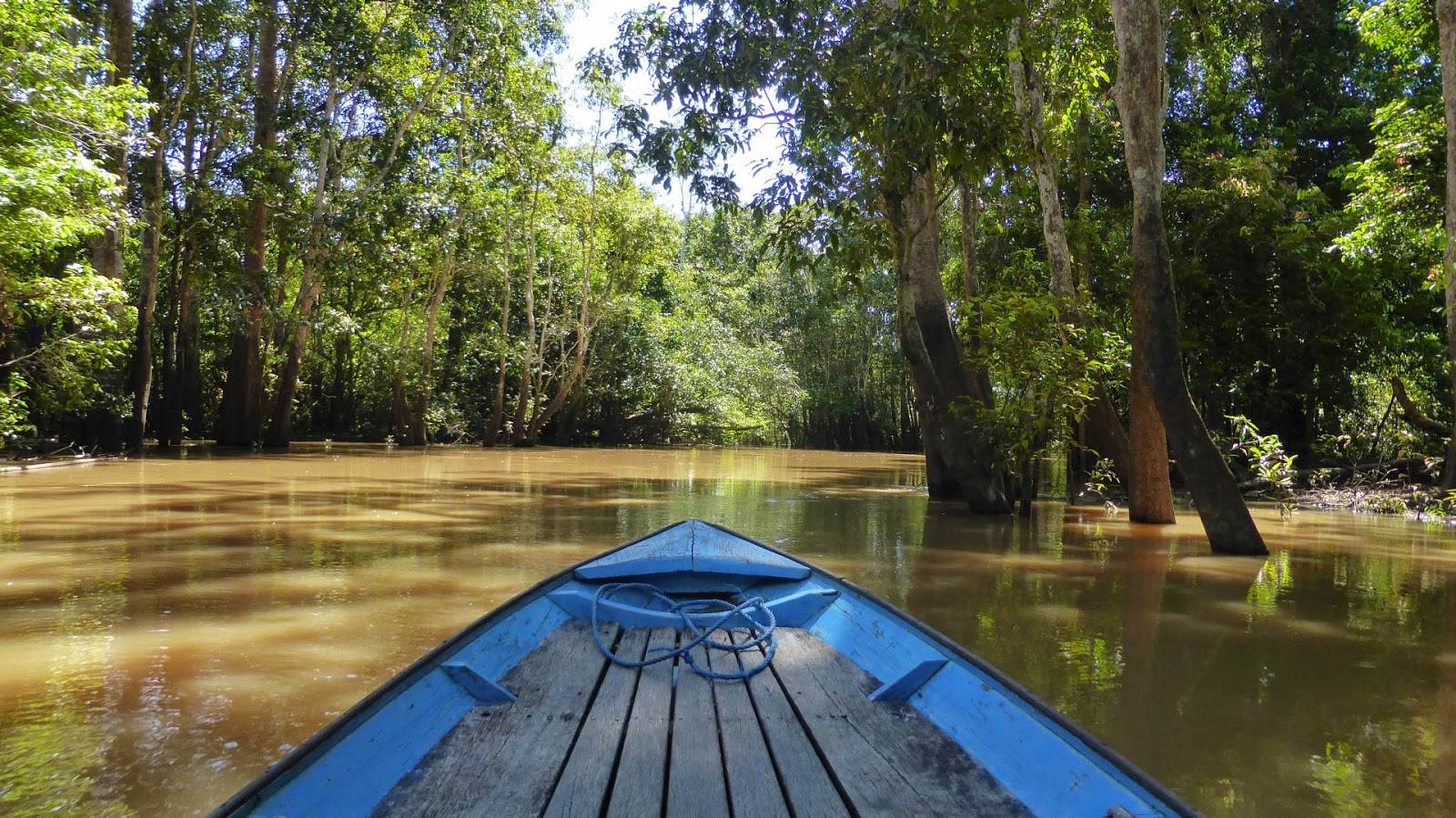
The scenery then changed again, as we entered a narrow meandering river through the forest and I couldn't help but smile straight away - it was the sort of jungle river journey I'd always dreamed of finding one day. We saw a couple of monitor lizards swim across in front of us, and some macaque monkeys foraging in the undergrowth on the banks. For forty-five minutes we weaved through these muddy waters, killing the engine to soak up the atmosphere for a few minutes along the way, and passing the odd fisherman manning Chinese fishing nets - large wooden contraptions with nets that dip into the water for their catch.

This was one of the best parts of the whole trip up the Mahakam - so exciting, beautiful and interesting, a real adrenaline rush.

On a ces boat passing down a passage through the reeds
... then entering the jungle!
Muara Pahu
We reached the small village of Muara Pahu around 2pm, and were dropped on a jetty where we were told we had to wait until night time to catch the ferry upstream. Some said it would arrive at 10pm, others as late as 1am, we had no idea. All we knew was that we were hungry and drained by the heat, so after lunch dozed for an hour or so in an open-sided waiting room by the river. It was at this point Rene said 'well this isn't a bad way to spend your birthday'. What! A birthday! I treated him to dinner and an orange juice that night. It cost me 75p!

We went for a wander around the village, and whilst stood by the riverbank a young tug boat driver waved to invite us onto his boat, so we went for a look. It was a bit rusty and old, and fairly small by tug boat standards being only able to pull small barges and boats around, but it was interesting to check out, and I even enjoyed a good poke around the engine room. He kindly offered us a soft drink, and despite the lack of mutual language we managed to converse a little by pointing a lot, and saying place names. We managed to while away the nine-hours of waiting quite easily, and at 11.30pm saw the lights of the ferry coming around the bend. As advised by the locals, Rene stood on the end of the pier flashing his torch and waving his arms to get them to stop, and we were soon on board, and led upstairs to an open area where everyone slept on thin narrow mattresses - eighty of them, and we settled down for the night under the drone of the loud diesel engine.

(Continues in two days time) 
Net fishing at Jantur
Volleyball match, Tanjung Isuy
The traditional longhouse we stayed at in Tanjung Isuy
Basic but all you need
Kids playing in Muara Pahu

Friday, 6 June 2014

Up the Mahakam - part I

Borneo Island, Indonesia

In this blog: we head off on a river trip, meet a plethora of helpful people, cruise across marshy lakes by longboat, and see the wild west on stilts.

--------------------------------------------------------------- 

Our route over 8 days up the Mahakam river
The Mahakam is a motorway on water except with little traffic - a massive river which leads to the heart of Borneo where no roads go. At over five hundred miles it's the longest river on Borneo island, and a journey upstream has been a must do for a while for me. So this past week Rene and I spent eight days on ferries and speedboats, heading inland to places as off the beaten track as I've ever gone, through marshes, lakes, jungle, to small tribal villages and by chance traditional local events. We've also encountered a lot of very friendly and kind people as you'll see. In a three part special (what's this, Top Gear?), here's what went down.
 ---
Sitting on the roof of a small chug-chug old ferry boat, we crossed from our last stop in Samarinda across the near kilometre-wide Mahakam river to the bus station. The contrast on the other side was remarkable; we'd gone from a modern concrete city to a dilapidated wooden slum in just a few minutes. On the half mile walk to the bus station, kids cheerily chased us and even more people than ever shouted 'hello mister' in our direction. 'Wow that was overwhelming' Rene said as we got to the bus station. We'd decided to cut five hours out of the river journey by taking a tiny minibus to the next city and I sat next to a pleasant man in his fifties called Safri who spoke a bit of English. He showed me photos of his family, told me about how he does instrument calibration for industrial plants, then curiously asked away about my trip, eventually deciding to give me his number saying 'any problems or questions in Indonesia, call me and I'll help'. Rene meanwhile was sat next to Handa, a 22 year old Muslim girl wearing the traditional headscarf, who was fascinated by his journey and photos.

Safri and Handa in the bus to Tenggarong
Myself, Rene, the ex-bf and Utariat their house
Tenggarong
We arrived at Tenggarong to find the bus station was way out of town, with no way to make the three mile journey to the centre. Handa suggested we walk before partway managing to flag down a van, which I assumed to be a taxi of sorts, but who knows. We got dropped by a cheap hotel that turned out to not have any spare beds, so walked around for a while hoping to find something with no luck. Stood scratching our heads by a busy street, a couple stopped on their scooter and asked if we needed help - a helpful friendly girl called Utari who's a primary school teacher, and what we understood to be her ex-boyfriend. They tried to phone a guesthouse they knew but couldn't get through, so after Rene and I grabbed some satay chicken for tea, they invited us to their house whilst we they kept trying the number. They seemed sound so we hopped on the back of the scooters and slowly wound a couple of miles to the edge of town, ending up in their colourful wooden house in the suburbs where we had a drink whilst watching part of an Indonesian football game on the TV between two local teams. Eventually a hotel was sorted and they dropped us to the door. More nice people.

Rene and I went for a stroll to track down a beer but found nothing - the Muslim influence on the city was obviously strong - substituting it for an ice cream instead. It was Saturday night and the huge market was closing up for the evening as we passed through, so we continued to the waterfront where a group of twenty or so superbike owners met outside a shop and chatted to us in excited bursts of English. Further along we heard music and crossed the road to find a rave in a skatepark by the road, in fact a 17th birthday party where the birthday girls wore ballgowns and everyone else jumped wildly to the pounding baseline, completely sober. 

We went for a look around the city the next morning, stopping for breakfast in a cafe where four girls of about ten giggled hysterically at us for a good few minutes, and breakfast consisted of a very spicy whole baby chicken - oh I wish I could understand the menus properly before ordering. We headed after to the nearby Keraton Museum; a very unique looking Art Deco building that used to be the local Sultan's palace, and only sees 10-15 foreign visitors a month. Probably because it was so boring inside we decided.

With our new biker dude friends
Keraton Museum, Tenggarong - the former sultan's palace
After a walk on the waterfront we decided it was time to move on and tried to get a lift to the out-of-town bus station. Except for some bizarre reason this was a city without taxis if you will. We wandered about and looked, did some waiting, got offered a lift by a guy on a scooter which we declined, but found no taxis. Indonesia feels safe, only richer people can afford cars, and we were a pair, so I proposed hitchhiking the three mile journey and Rene was keen. Within under a minute of sticking my thumb out a car pulled up, and the pleasant driver turned out to not only be going past the bus station, but heading to our destination of Kota Bangun. We hopped in.

The driver was Jul, a guy in his late twenties who was married with two kids, having met his wife whilst working working in Pizza Hut elsewhere in Borneo, the thought of which seemed a million miles from the simple rural villages we were driving through at that moment. He told us he was a taxi driver on a return trip but didn't want any money from us, I questioned it in my mind, but he was true to his word and even bought us lunch in a cafe along the way - oxtail soup and rice, refusing to take any money for it. He told us how he learnt English by watching Hollywood movies (I've heard this a few times now) and chatting to people, and played the usual mixture of terrible dance music and mildly better pop music. It was a first for me to see beggars on country roads - often in the middle of nowhere, where they put tyres and boxes in the centre of the two lane road to slow traffic and held out cardboard boxes or fishing nets to collect money. Very odd, but Jul assured us that's exactly what they were doing. Arriving at the riverside town of Kota Bangun, he took us on a short diversion past his house, lowering all the tinted windows as we slowly passed his Mum and friends as if to say 'look! I have foreign friends!'. 

Lake cruising and Melintang stilt village
We were now back beside the huge Mahakam river, and at a point where some large lakes and marshes open up to each side. The best way to see them was by chartering a ces - a colourful, long and narrow boat powered by a noisy lawnmower engine. Jul had a friend who was a driver so phoned him to meet up with us at the harbour, then helped us translate to negotiate a price before disappearing off - what a delightful guy.
This was turning out to be one action packed day and wasn't over yet. 

With a ces hired for the next hour or two we headed out on the lake. It was a warm sunny afternoon and we felt like kings (but looked like tramps) cruising about on this chauffeur driven boat. The lake looked endless as we cruised across it but got a bit repetitive, so I directed him towards the marshy area at the edge. We went along slowly, spotting a few ibis' and kingfishers. Further into the marsh we could see some fishermen in wood canoes punting their way through, and we stopped for a while whilst they slowly worked towards us. It was a great moment, a very real encounter with a traditional way of life.

Even more remarkable was the next place we reached - Melintang, a town built within the marsh entirely comprised of wooden houses built above the water - a kind of Wild West on stilts and quite magical with it. It was accessible only by boat and so different to anything I'd ever seen before, the sort of thing you see in a David Attenborough documentary - I even questioned whether I was still on this planet (was I ever?!). The pace of life was obviously slow, except for a group of kids who had put a running hose pipe at the top of a wooden ramp and repeatedly slid down into the lake below, or jumped off the adjacent pier full of joy and excitement. I was truly blown away by this place.
Fishermen punting through the reeds
On Lake Melintang

Muara Muntai
The boat then entered a small river maybe five metres wide to connect back to the main one. For half an hour we weaved round bend after bend, and whilst we saw nothing special it was another interesting change of scenery. Arriving at Muara Muntia at sunset, we stopped for the night in an extremely basic wooden guesthouse. 

Muara Muntai, like the previous village was very unique. Remarkably there were no roads, just a wide wooden boardwalk that stretched for a mile and a half, raised a couple of metres from the riverbank below. Everything in sight was made of wood and often colourfully painted, not surprising given that Borneo is mostly covered in trees. There was a remarkable sunset with rayed beams of light that evening, and as we wandered through this town which sees few Westerners people were very friendly to us. Despite being off the road network and a few hours from civilisation, everything you could need was available in then night market, a curious mix of old world and new world.

(Continues in two days time)
Approaching Melintang, some view
One of the most sunique sunsets I've ever seen, Muara Muntai

Tuesday, 29 April 2014

On The Road

Sibu, then Niah National Park, Malaysian Borneo 

In this blog: on buses and boats with the Borneo travel gang, a quick city stop, and one of the biggest caves in the world.

--------------------------------------------------------------------------------

After nine months of travelling on my own - happily and willingly, but largely by circumstance rather than choice, I've managed to group up with two sometimes three other backpackers who are heading the same way as me, and over three days we've travelled up the north coast of Malaysian Borneo stopping at cities and sights on the way.

Logging barge on journey from Kuching to Sibu

Because of it's huge rivers, thick jungle and relative lack of population, Borneo doesn't have a lot of roads, so it turned out the best way to take the journey from Kuching to Sibu, was along the coast by boat - a four hour journey vs eight hours by bus. The other guys had left the day before so I headed off alone on the local bus to the ferry port, grouping with three other travellers to find the port amongst a maze of industrial estates once the bus had dumped us in the middle of nowhere. The journey was really interesting, albeit a bit uncomfortable - on the outside deck it was so noisy I could feel my eardrums rupturing, but inside the aircon was turned down so low that early signs of frostbite were visible. The solution I decided was to spend whole journey flipping between the two, thus only being part cold and part deaf, the best of both worlds. The scenery was fantastic though - leaving Kuching and heading up the estuary, going out to see for a couple hours then back inland up another huge, and I mean really huge river, lined by jungle, small villages and over a hundred sawmills along the way, whilst passing huge barges of trees being towed downstream. Deforestation is a big concern in Borneo - the oldest rainforest in the world, and it's very clear they're flat out working at it.

We reached Sibu - a commercial city about fifty miles inland from the sea which was pleasant enough, if not a little short on anything interesting to see or do. With Max who I'd met in Kuching, and Alan, a Dutch guy we'd met earlier that day, we got a little lost looking for a guesthouse, by chance bumping into Canadian Rene and Belgium Christophe on the street by chance who led us to the place they were staying at. The rest of the day was spent sometimes as a group, sometimes apart, having a look around. The biggest market in Malaysia was interesting, particularly seeing the way they sell chickens - live,p but wrapped up in newspaper and string. I had a look in the Sibu Heritage Centre, learning more about the British colonial days and the huge numbers of Chinese immigrants who now dominate. I stopped at a beautiful seven story Chinese pagoda nearby on the riverbank, where I bumped into Dutch Alan again and we climbed it to see the view. He was a bearded guy, slightly older than me, who told me of how he'd visited every county bar three in the Asian continent, and lived in Calcutta, India for six years doing social work on the streets - an very interesting and nice guy, if not a tiny weeny bit of a travel snob with it occasionally. We all met up again that evening and walked to the town's night market, where under a bustle of blue gazebos people sold everything and anything. The food section was what we were interested in, and I took a pick and mix of Pork Bao (steamed Chinese buns), Malaysian thick noodles, and some meat on a stick- chicken, baby squid and an unidentifiable meat as sometimes happens in Asia. 
\
Live chickens in market, Sibu

Chinese pagoda, Sibu

Night market, Sibu

Half a day in Sibu was enough and the next morning with Canadian Rene and Belgium Christophe, we took a bus five hours north-east which with it's comfy seats and air-con was a total contrast to my experiences in India. Rene and I talked travelling and decided to travel together for next few weeks round Borneo. Christophe slept. Deforestation of ancient forest, both legal and illegal but controversial nonetheless was quite visible out the window. We passed many longhouses, kind-of the Malaysian version of British terraced housing, and many freshly built big empty property developments en-route - over speculation perhaps, or just people putting all their oil and gas money somewhere safe. Most of the journey though, the scenery consisted of nothing but 
Jungle
Palm oil plantation
Jungle
Palm oil plantation
River
Swamp
Longhouse
Jungle
Palm oil plantation
Jungle
Palm oil plantation

We hopped off at a little service station in the middle of nowhere, and made the short journey to Batu Niah via my first experience of hitc, a slightly odd little untouristy town outside the gates of Niah National Park. It had a bit of a frontier outpost feel to it, being full of drab concrete buildings and pick-up trucks thanks to being based around logging and palm oil we assumed. We shared a two bed room between three in the only hotel in town, with Rene on a bed, Christophe volunteering to sleep on a rock hard bed base, and me on a mattress on the floor - the things you do as a backpacker to save a few quid sometimes! We went for a wander, laughing at all the fake bottles of spirits in the supermarket, before buying a £3 random bottle of a Chinese spirit to try later which turned out to be a bit like rum. Rene spotted a basketball court, and we watched some locals playing for a few minutes before before they invited us to join in for a mess about, speaking a little bit of English between them. All of us were rusty as can be but it was a good fun nonetheless. 

Me making friends with the locals, Niah Batu

Playing basketball with the locals, Niah Batu

The next morning we walked a couple of miles to the park office then took a boat across the river into the main area. Niah National Park. The park is based around a huge limestone outcrop which sits in the middle of an otherwise flat area, and people visit to see it's network of caves within as well as some prehistoric rock graffiti, and excavations of the oldest evidence of human settlement in south-east Asia - about 40,000 year old. 

We walked along a raised wooden pathway through the jungle, passing over swamps, seeing a variety of small and very different looking insects. An excitable Malaysian girl stopped and chatted to us, later inviting us to meet up for drinks in Miri in a couple of days (which we forgot) - that would never have happened in India I thought. After half an hour we reached Traders Cave - a huge overhang set into the hill, sported by huge natural pillars, looking like a piece of cutting edge modern architecture, except as natural as can be.

A little further up the valley we entered The Great Cave - one of the largest caves in the world, with a 250m wide by 60m high entrance. My jaw dropped, it was bigger than anything I'd ever seen - I reckon you could park five jumbo jets in there, with space for a small stadium beside. The scale was just beyond what my mind could process, truly awesome. Within the spcave were various wooden poles which went from the ground right long way up to the roof, which locals precariously climb to collect the nests of Swiftlets for Birds Nest soup. Believe it or not, this expensive Chinese delicacy contains actual birds nest - the saliva of the swiftlets dissolves to give it it's flavour.     

We spent a couple more hours exploring further into the networks of huge cave passages, walking on wooden boardwalks, sometimes lit by other entrances and sometimes requiring torchlight. It sometimes felt like the whole mountain above was just a hollow shell, such was the scale of it all. After sheltering from yet another huge downpour, and seeing some ancient rock paintings which really didn't do anything for me despite their significance, we were on the road again heading for the city of Miri.
An incredible sight we spotted on a washing line, Niah National Park

With some HUGE butress roots, Niah National Park

Traders Cave, Niah National Park

The Great Cave, Niah National Park

Ancient rock art, Niah National Park

Red millipede, Niah National Park