Showing posts with label cinema. Show all posts

Saturday, 14 June 2014

Make it Snappy

Balikpapan, Borneo island, Indonesia (map)

In this blog: a strange friend, spolt by local ladies, flight nightmares and a crocodile farm.

--------------------------------------------------------------------------------------

After a month where the longest I'd stayed anywhere was four days, I wanted to stop. I was tired of the road, tired of moving, just tired. In a funny way then it was fortunate then that the city of Balikpapan was nice but boring - a good place for a bit of normality of sorts. But even when i do everything in my power to have a quiet week including spending three days solid on a computer - fun and games still seem to follow and interesting things happen.

---

After the epic boat journey we'd had the week before up the Mahakam river, Rene (my Canadian travel buddy) and I arrived back at the city of Samarinda and took a bus to Balikpapan, a journey uneventful bar a busker briefly walking onto the bus playing guitar which made us smile. Once in Balikpapan centre it was back to civilisation, or so it felt anyway. We headed straight to the bakery, after ten days or so without bread left us craving carbs like you wouldn't believe. We then set about finding somewhere to stay, but every place we found was either full, expensive or grotty, and it took a frustrating and sweaty two hours of lots of walking about to finally find a bed - thankfully a fairly rare occurrence on this trip. We relaxed for a bit, walked along a dodgy waterfront market, had tea at a funky cafe with a live band, then passed a party we spotted earlier only to find we'd annoyingly just missed out on free food for all. 

The next three days were a blur of computers - two full days of writing blogs on my tablet in the room, then one day copying and uploading pictures in an ear-poppingly noisy and sweaty internet cafe; it all takes forever. The evenings provided some light relief though. I shaved off a five-week travel beard, wandered past a little cafe called 'Bude' (like the Cornish town), then watched some guys playing chess on the street. A local guy got chatting to us - a commercial diver, who upon hearing we'd done some diving recently, instantly whipped out his tablet, and full of joy and excitement showed us underwater videos he'd downloaded from the internet.

Another night we fancied a beer, but being a Muslim country it can be hard to get hold of at times. We asked a guy on the street and he pointed up towards some market stalls and getting there, we asked the owner. She nodded gently, as if to say 'yes, but keep it quiet' and told us a price. As ever in Asia we tried to negotiate, only for her to shake her head in disgust at the price and totally offended, walked away back to her friend. We were as shocked as her, that never happens! When we asked another guy nearby his eyes darted from side to side, before he reached under the counter and quickly pulled out two bottles and put them straight into our rucksacks like nothing had happened, as if it was a drug deal or something.

---

Stenly
We were having a wander one evening when a young local guy casually said hello and introduced himself as Stenly, a pleasant but slightly strange young freelance English teacher. 'That's not a very Indonesian name' I pointed out and he agreed without explanation. We asked for a recommendation for somewhere to eat, and he pointed out a place and walked off, before catching us up again saying 'actually there's a better place across the road' and led us there. 'Across the road' ended up being a mile away up a hill, and after an excellent buffet of fish dishes he suggested taking a bus back, which he assumed we would pay his share of. It was cheap, so fine. We went into the Internet cafe where he said he was going in the first place and whilst we spent two hours there, oddly didn't actually use a computer and just sat there chatting or texting.

The following evening Rene and I went to the cinema to see 'Edge of Tomorrow' and he asked if he could tag along. Without realising it we had inadvertently bought tickets in a VIP screen before he arrived where there was just thirty huge plush electric recliners, acres of legroom, a call button for drinks and popcorn, and a blanket each to tackle the ice cold aircon. I'd never experienced anything like it, and at £2.75 it was a complete luxurious bargain. Afterwards when it came to paying though, Stenly said he'd forgotten his wallet saying he'd meet the next morning to pay us back. He never showed up nor replied to any messages. It was only a couple of quid each so the money was incidental, and in the end we decided that he just saw us as rare white 'friends' who could afford to treat him. However, this money soon balanced back out as you'll read later.

---

Crocs
Balikpapan is a pleasant city thanks to money from an economy based around the many offshore oil platforms nearby, but is pretty short on anything interesting to see. This was fine with us as we wanted a break from sightseeing, but one attraction was too much to resist - a nearby crocodile farm. It was a proper hoohaa to get there thanks to a bus driver mishearing where we wanted to go and a one hour journey turned into nearly three, but it was worth it. 

The bus dropped us in an unassuming spot and we wandered down a quiet lane between some buildings, eventually finding the complex of delapated buildings that formed this commercial crocodile farm which reared hundreds of these brutes for their meat and skin. Inside were a number of concrete pens, which we soon discovered were held shut with nothing but toilet door latches or bits of bent wire - I kid you not! I tentatively looked over the wall for my first glimpse, and the hairs on my neck stood on end briefly. They were grouped by age and pretty packed in, often lying on top of one another motionless, expect for the occasional splash as they quickly moved into the water. 

I motioned to one of the staff to ask where the crocs were killed and he pointed over a wall, so I climbed on a bench for a peek, quite taken back to find the peculiar scene of hundreds of decapatated crocodile heads laying on top of cages. Outside as a side attraction a couple of elephants with chains round their ankles grazed in a field, and some monkeys were kept in small rubbish strewn pens, not very pleasant and the stuff of nightmares for animal rights activists I imagine. I probably only encouraged this more when upon seeing an old guy offering, spontaneously decided to break a phobia of mine by holding a snake for the first time. The skin felt like latex, and the bones were very prominent underneath though thankfully it didn't really wriggle much. It's mouth was curiously held shut with Sellotape, but whilst a little creepy at first, the experience was actually quite tolerable. Another 'things to do before you die' box ticked.

---


With the babies
Personal space? Pah!

The butcher's yard

Where next?
Borneo is a big island and in my mind without thinking I was going to see it all, until Rene mentioned he was thinking of moving on. It had been two months since I arrived from Singapore, and as much as I love Borneo's wild beauty and off the beaten track adventures, suddenly I realised I needed a change. It was time to move on. For a few days it looked like our travel partnership was coming to an end, as we both had different plans since Rene had visas to get for the journey ahead, but at the last moment he worked out a different way of doing things and decided to join me to the crazy looking (on a map at least) Sulawesi island.

The ferry schedule to get there didn't work with our timing, so once again I found myself in the position on trying to book a flight for the same day. It's not normally a major issue as prices don't really go up last-minute in Asia - but on this occasion things conspired against us with flights going up in cost before our eyes, selling out, two lots of payment problems and having to stay another night. After a whole frustrating afternoon disappeared by, eventually we resorted to a good old-fashioned travel agent nearby who surprisingly did it for the same price, and our Borneo exit was sorted.

---

Kept men
One night for the week Rene and I stopped at a quiet bar on the waterfront for a drink and got talking to the owner - a 27 year old girl called Ubai (short for Djubaidah), a petite, pretty and chatty 'businesswoman' as she called herself, divorced with a seven year old son. Little did we know what was going to follow!

I mentioned to her I was going to get a haircut the next day. 'I'll show you where to go if you like' she said, so Rene and I met up late the following afternoon with Ubai and her friend Liona. It turned out the place was a few miles away, and she insisted on chauffeuring us there in her shiny one week old Honda wagon. Arriving at this fancy mall the hairdressers there was way too fancy and expensive for my backpacker budget, so we went for seafood soup and rice in a restaurant nearby and Ubai insisted on paying. She then took us to a little neighbourhood barbers nearby where they pruned Rene's mop and travellers beard into a work of art then butchered too much from mine, and this time Liona insisted on paying - the grand sum of £0.75 each! 

The girls had planned to go out to a bar that night and invited us to join them, so a couple of hours later Ubai and another friend of her's - Nila, an accountant, collected us and drove a few miles out of town. We reached Joy's bar, full of mostly foreign male expats and local women, and was pretty lively with it's live band and people getting up and dancing on the bar. Most of the expats work locally in the oil and coal industries, and one of them, a chubby double-chinned Kiwi guy who deals with hydraulics came and chatted for a while, crushing our hands with the most almighty of handshakes and proclaiming his love for living in Balikpapan. The owner Jerry introduced himself and handed us a free tequila, whilst a local girl beat every person in the house (including me) at pool. We met loads of people through the girls and had a great night out, yet once again when it came to paying our bar bill at the end of the night, we found the girls had already done it and once again wouldn't accept our share - over £25 of it! As we had a flight the next day, we said goodbye and went home in disbelief at the generosity.

---

It wasn't over though 'cause the next afternoon I received a message asking if we'd like to hang out before our flight, so with a few hours to spare Ubai again drove the four of us to a smart beachside restaurant where the moneyed middle-class hang out, and we had a few fruit juices and chatted away for a couple of hours. Their English was excellent having worked for international companies based locally, and despite our insistence otherwise, the bill was paid again and we were dropped at the airport before saying goodbye. 

Rene and I sat in the departure lounge a little dazed by the whole experience. On reflection we decided it was a mixture of the Indonesian warmness we'd experienced previously, and maybe just a little bit of Indonesian women using their money to attract western men, even if they didn't push that idea too much. You know these stories you hear about western men buying foreign brides? Well, in a strange turn of events somehow the opposite nearly happened to us. There's no wedding bells, but a fun story all the same. 

---

So after two months on Borneo, the third largest island in the world, that's it. I knew it wasn't going to be the untapped paradise it sounded and once was, but I was still surprised by both how developed it is, and just how much it's been ruined by logging and other more dirty industries. There's still an amazing amount of natural beauty though in the primary rainforest when you find it, and some very exotic plants and creatures. Was it what I expected? Yes, and more.

Busker on the bus
Rene desperate to tuck in
Indonesian's like to adapt their scooters for all sorts of purposes
Hard day at work
Rene, Nila, Ubai and I by the beach

Friday, 7 February 2014

Some Richer, Some Poorer


I needed a break. A break from moving every four or five days, from looking at stuff, working out where everything is, planning what to see and do, and from the constant haggling. I just wanted a bit of normality, a bit of purpose and to stay in one place. 

As much as I love travelling, you can have too much of a good thing sometimes. I had a contact who ran a charity in Pune, a few hours from Mumbai, whom I'd met and helped out a few weeks before, so decided a good way to live a bit more normally, be productive and contribute something to this country was to do some volunteering. 

Manish
You see poverty everywhere in India and it makes you feel pretty helpless, and indeed guilty for having so much yourself, a common feeling. Giving money to beggars is pretty unconstructive as I've mentioned before (it creates dependency, there's too many of them to make a difference etc), so I wanted to help in a more constructive way. Asha Kiran, managed by my contact Manish Stroff, is an NGO based in the city of Pune (pron: Poona) that runs a children's hospice, a community kitchen, and a number of crèches on building sites, and seemed like a good organisation to work with. 

Monday 20th January 
Quietly it's a fear many people have, but is one of those things you never expect to happen to you. I got stuck in a lift. 

I'd awoken early at the hotel in Mumbai to pounding techno music - not something you generally hear in India, but this place is full of surprises - and went to leave the hotel in the lift. I descended five floors and thought I'd reached the bottom, so slid across the old-fashioned manual concertina door, the type you'd see in a 1930's movie, to find it was still in fact between the first and second floor. I shut the door again and pressed the button, but nothing would happen. I couldn't go down nor up, and there was no emergency hatch or telephone link. There was however a buzzer you could press to attract attention, but helpfully it was only loud enough for me alone to hear. Thankfully it didn't turn into the disaster that it could have been, and fifteen minutes later the lift miraculously sprung into life again and I was on the way to catch a bus to Pune.

---

The journey was remarkably good for a change, taking what's considered a luxury bus along the country's only six lane motorway, passing massive hoardings for luxury housing developments, IPL premier league cricket stadiums and luxury German car showrooms along the way. This was an area with money. Of course, you're reminded straight away that you are still in fact in India, when the bus stops twice on the motorway itself (not even the hard shoulder) to drop people off.

Arriving in Pune at lunchtime, I got a rickshaw to Asha Kiran's office and met the four people working there, who spoke some English but seemed quite shy, apart from Manish - the Indian director of this Spanish-formed charity, who even speaks English with his wife at home. Manish is a top guy, very welcoming and helpful, and after a spot of lunch took me on his motorbike to find somewhere to stay, which ended up being in the house of a family who generally take in long term guests. My thoughts of getting stuck-in with work straight away were quickly dampened when I found out there was nothing to do that day.

Tuesday 21st
After a typically Indian breakfast of an omelette sandwich, a dosa (fermented rice-batter pancake) and of course a chai (masala tea) I walked to the office, based in the posh Koregaon Park district of the city. When I say posh, this was the Beverly Hills of India and I'm not joking. I passed one huge mansion after another, all with security guards and grand entrances - homes of various businessmen and industrialists, including one of the top 500 richest men in the world. It was a very different world to what I'd seen in the past couple of months.

Manish and I chatted about suitable jobs I could help with for the two-week stay, and despite his prior assurances that there was loads to do, it didn't seem like there actually was. My heart sank a little to think I'd given up two weeks of my time and paid up-front for accommodation, 'would this be a waste of time?' I wondered. He soon decided they needed some proper photos on the website; right up my street, so sent me off with Rajesh - one of the guys in the office, to some of the building site crèches they run. 

---

Crossing the city on the back of his motorbike, it was apparent that despite being a more affluent city, this didn't stop the traffic from being typically lawless and chaotic. We arrived at a large building site of some part-finished blocks of luxury apartments, and reached the temporary village where the contract labourers were housed. The contrast and irony was immediately apparent - luxury flats being built by poorly paid folks living temporarily in tin shacks. The government requires that facilities are provided for the children of these workers, and for once the law seems to be adhered to even if the crèches are less than basic. The kids seemed happy though, after all they were young enough to not know any different, and after taking a load of snaps I was invited to join in some of their games, one of which was like an Indian version of 'it'.

I went to the cinema that night in a luxury American-style mall nearby and saw a Hollywood movie called Jack Ryan. Once again then cinema was fantastic, as good if not better than anything at home, and a bargain at £1 entry. The movie was excellent, but I was more amused by the strange method of censoring they used. The spoken words in English weren't censored, but the subtitles strangely also in English were. Rather than just putting the normal astrixes in place of swear words though, they replaced them with darned, blooming, fricking and so on, but in a totally illogical order, giving strange lines like 'I wish you'd just gosh off', and 'this is a load of darn' which made me chuckle. Leaving the posh enclave of the cinema I got chased briefly on the way back by three street dogs, then walked past people sleeping rough on the streets. Yep, definitely still in India.

---

Wednesday 22nd
The Indian work ethic can be a little different to what I'm used to. The Asha Kiran office starts at 9 - 9.30, but I found myself waiting for it to open until 9.30, followed by half an hour or so of everyone reading the newspapers before cracking on. To be fair, they do work until 6pm or later so it all balances out, it's just a different way.

I visited another couple of building site crèches with Rajesh to take more photos for their website. The big sites appear fairly professionally run, with compulsory helmets being worn, actual portajohns, and proper steel scaffolding instead of bamboo. I was given a chai in the site hut, where the labourers took a break and watched some India vs New Zealand cricket live on the TV. Asha Kiran run a kitchen that delivers meals to all the crèches, so at lunchtime I was invited to join them to eat, sat cross legged (or more like sprawled in my case) on the floor, eating curried veg, rice, curried boiled eggs and a soup with our fingers, ripping off small pieces of roti bread to pick everything up. Messy, for me anyway.

---

Thursday 23rd
After another slow morning in the office, doing my own things whilst waiting for a job to do. I later went with Rajesh to a couple of other crèches on these edge-of-town new build sites. On the second site, Rajesh had to meet the site manager so left me with the teacher for an hour, as well as the very friendly construction Camp Manager, Nivrati who bizarrely also taught the kids sometimes. Crèche is a very loose term in this case, as the kids are between three months and eight years, so they're sort of schools really, though without a proper curriculum or qualified teacher. Better than nothing I suppose. I was given the honour of entertaining the kids for a while but it's not exactly my area of expertise; it's been a few years for me since school and there was the obvious language barrier as well so it was a pretty terrible attempt. On the spot all I could think to do, which you'll laugh at, was get them to attempt to sing and do the hokey dokey (I forgot half the verses), sing humpy dumpty by following me, then arrange themselves by height order then age order. The kids once again on the face of it seemed to be happy and well-adjusted despite the basic conditions.

Workers' accomodation
Nivrati then showed me round the labour camp (workers accommodation) which though very basic was clean enough and well run. I spotted a farm next door so persuaded him to take me for a look. On a scrubby piece of ground, and surrounded by building sites on all sides was a shed with a couple of sets of cubicles where about a hundred buffalo were tied to their stalls - it was an urban dairy farm. I was actually surprisingly impressed. They were fed plenty of vegetation of some sort in concrete troughs, they had access to water and the passages were regularly scraped out into a concrete slurry pit. Very interesting, for someone who's lived on a dairy farm much of their life anyway. Buffalo milk actually makes up 54% of India's milk production, the largest producer in the world - interesting article here.


Buffalo dairy farm

We finished up by visiting a community centre that Asha Kiran run in one of Pune's slums. A group of around twenty women were on the last day of a three month free tailoring course that had been organised. Like the few other Indian women I'd met they were fairly shy, but were pleased to show me a selection of garments they'd made, and allowed me to take photos for Asha Kiran. 

---

Friday 24th 
An introductory computer course was soon to be starting, and Manish had six or seven second-hand computers in the office that had been donated by local companies, that needed checking and testing before being taken to the slum community centre. So after an hour of this, disappointingly my day was done. 

I hung out for the afternoon to use the internet, and chatted with a pair of Spanish and Portuguese women who came in for a while to see Manish and use the internet, who are former volunteers. One manages a factory nearby that makes labels that go in clothes, and the other works on theatre shows in different parts of the world, and was in Pune for practice and research. Interesting lifes. I told Manish I'd like to really get stuck into something the next week, and he promised there would have more on offer. To be fair to them, two weeks of volunteering isn't really enough to get someone like me established and properly setup, so it was the situation that dictated, more than anything else.

Saturday 25th
View from Parvati hill over nearby Slum. 
Note the satellite dishes - simple relief from
poverty, or unnecessary extravagance? You decide.
Even though I was in Pune for a break from travelling, I couldn't help but see a bit of it, so decided for the first time on this trip to hire a scooter to explore the city. I've ridden one a few years ago on some quiet roads in Thailand and Cambodia, but on the crazy city roads of India, this was a whole different story. All I can say is I got used to it, and survived. I hated it at first I must admit; the other drivers are so ignorant towards each other, but I soon learnt to become ignorant myself. I rode to Parvati Hill, a nice vantage on a hill surrounded by the city. I continued to a nice park, where a women came out of nowhere to try and a red dot on my forehead whilst I sat relaxing, and I saw a guy eating a curry literally out of a clear plastic bag, using just his fingers of course.

---

Pateleshwar Cave temple was an interesting stop a bit further on, a rock cut cave temple built by digging a big hole in the ground, then excavating sideways into the hill. Inside, they'd carved out a huge room, leaving moulded columns and shrines - all from the original material without putting anything back. It was very impressive and reminded me a lot of Petra, Jordan where I went a couple of months back.

After more aimless cruising and exploring around the city on the bike, I stopped at one of the big posh malls to see what it was like. It was Independence Day throughout India that day, which didn't turn out to be the celebration I expected, but the mall was packed with people waiting for some entertainment on a stage put on for it anyway, which I must add was terrible. I looked around a huge supermarket briefly, since I'd not actually seen one the whole time in India, and it was based on, and partly supplied by the UK's Tesco, with loads of their products and signs present; a strange sight so far from home. Apart from that it was a typical mall, large soulless and boring, yet I couldn't get over how high quality and well crafted it all was - another world completely compared to the typical street shops and stalls of India. 

More from Pune soon.


Monday, 3 February 2014

More Mumbai


In this blog: a laundry with a difference, the posh side of India, a marathon and a very different cinema experience.

-----------------------------------------------------------------------------

Everything breeds well in India - cows, monkeys, dogs, birds and most of all, people, but strangely something I've barely seen is the common pussycat. I was surprised then, that Mumbai was the first place I'd really some across cats, though still only in sensible numbers. They say cats are intelligent, so obviously they understand the overpopulation issues well, and abstain for the sake of their country. Noble creatures.

18th January
Still exploring the huge city of Mumbai, I took a commuter train north from my base in the south of the peninsula to Malabar Hill, a fairly classy part of town which wouldn't look out of place in any developed country. This is the thing about India; yes the chaos and poverty is the bit that sticks in people's minds, but there's also a large middle-class and upper-class population that can afford to live well. Malabar Hill was nice to wander round, with some lovely parks, modern flats and houses, and dramatic banyan trees overhanging the roads - a tree with loose drooping vines which would allow Tarzan to commute around the city pretty quickly. Was Tarzan Indian I pondered? There were also hundreds of eagles circling overhead, thanks to a walled area nearby where a certain religious sect places the bodies of their dead on plinths to decompose naturally... or rather be pulled to death by vultures and birds of prey. Interesting idea.

View from Malabar hill district


On the way to Malabar Hill, as I walked along I couldn't help notice tens of thousands of Police along the streets, not doing a lot as ever, but obviously prepared for something. I asked what was happening - 'nothing, nothing at all' said the first in a strange denial of something that obviously was happening, the second spoke in English but didn't make any sense, finally the third told me there was a Muslim march happening in honour of a leader who'd just died. Hindus and Muslims generally get on well, but there are definitely some underlying tensions, so I guess the Police were just very prepared. After Malabar Hill, I strolled down to a nice middle-class house named Mani Bhavan - Gandhi's house in Mumbai for many years which is now a small museum. There were some interesting letters he wrote to world leaders at the time, and a small collection of photos, most interestingly him hanging out with with Charlie Chaplin, a unlikely pairing I thought. 

---

Mahalakshmi dhobi ghats - the laundry
Stoking the fires
I continued on to Mahalakshmi 'dhobi ghats' - a huge outdoor maze of rough and ready buildings and washpools that serve as the city's washer-dryer - most people send their washing here rather than do it at home it seems. I looked down over the area from a bridge along with a few other tourists who soon came and went, and decided to wander down to it to have a closer look. A local guy started pestering me to go on a tour around. I only wanted a quick look on my own really, but eventually relented and agreed a price. Paying to see a laundry eh?! He then slyly sent me off inside with his mate, who it turned out could barely speak English, and instead of a half hour tour, it was only just a quarter of an hour. Whilst it wasn't a lot of money to me, I left at the end with a bitter taste in my mouth at having being deceived somewhat. It was however a really interesting place to visit, where over two thousand people separate and wash the garments in concrete troughs, often stood in them themselves, before smashing them hard against an angled slab of concrete. 

Other people were then hanging, carrying, drying, ironing and folding. He led me into a long dark and dirty building that surrounded the site, where there were old oil barrels full of chemicals bubbling away, used for removing stubborn stains. A guy walked along the row of them with a long stick, stoking the fires below. It was a nasty place to work, and I would imagine life expectancy is pretty short for anyone in there. What you can't see from outside the area however, is that only some of the clothes are washed by hand - many are done by huge machines and dryers, so it's not all as primitive as it looks.
Aussie Shaun in Zoe Cafe-Bar
The weather in Mumbai was perfect; twenty-nine degrees but not humid with it. I wandered on through a working class neighbourhood, though for a change nothing really stood out as interesting or different, and stopped at one of the many home-made cake shops and tried a Ladoo, a small orange coloured ball of doughy, syrupy texture. Indians definitely have a sweet tooth. Shaun text me, the Australian guy I'd been hanging out with who I first met a month before, and I went to meet him for a beer. The cafe-bar we visited was in a creative hub of the city, and I was surprised at how classy, well designed and just plain cool it was. It wouldn't have looked out of place in London, and the clientele were all young, hip and affluent, something I'd not seen much of in India thus far. A total contrast to the areas I'd been in earlier that day, such is the diversity of Mumbai. 

We went for a Chinese afterwards - something you find surprisingly often in India though they're never run by Chinese - before heading back to the hotel. Almost home, we chanced upon a local bar, the first I'd been to in the country believe it or not, they're not that common. It was a stark white room with wooden benches, devoid of any character, and had more staff than customers which is about normal here. We were surrounded on all sides by stacks of boxes of beer bottles, making it feel more like being in a stockroom than a bar, and a few locals sat around quietly watching cricket on the TV. It's fair to say going to the pub isn't really an instringsic part of Indian life. Sean studied philosophy at uni, so we whiled away some time trying to decide the meaning of life, 'is it all pre-destined, or just meaningless random events' was about the cut of it. No conclusions were drawn.

---

Sunday 19th January
I'd seen a lot of impromptu cricket being played around India, but until now no organised games on proper pitches. Mumbai has a huge area in the centre called Oval Maiden where there are about seven pitches side by side, and being a Sunday it was ram jammed with locals in their cricket whites playing matches, some for fun and some more serious. Despite not really being a cricket fan, I stopped for half an hour, and watched the passion with which they treated the game.

Mumbai marathon
It was a sports morning, 'cause a little further along I reached a road barricaded off and lined with people, for it was the day of the annual Mumbai marathon. I'd missed the main action, as the 10km and elite runners had set off early to avoid the heat - the first race was at an unbelievable 5am! It was still good to watch and professionally run, though typically Indian, with most runners being both natives and male, with the odd Chinese or westerner having a go.

Tiffin carriers, aka 'dabbawallas'
Nearby, I saw for the first time a Mumbai phenomenon I'd heard a lot about. At lunchtime everyday, local men in white cotton coats and funny white hats, carry tiffins (stacking food tins) containing freshly-prepared lunches from housewives at home to their husbands at work. It's quite a sight, seeing lots of these guys walking or cycling around, overloaded with these colour coded bags. A very efficient system apparently. I took the commuter train north, and was interested to see people growing vegetables on the narrow area between the two sets of train tracks  - no land goes to waste here. 

---


Party time
At the Bhandra district, another middle-class area, I went for a walk to the coast, surprisingly passing a large Marks and Spencer along the way, followed by a Portuguese church - a legacy of their time in certain parts of India. Hearing a lot of noise, I stopped with some other people to look over the wall of a community area which was having some sort of games day, and ended up spending nearly an hour enjoying watching the action. Four colour-coded teams were competing against each other in different party games, such as to make the longest complete straw out shorter drinking straws, and dance together to music whilst swinging around balloons. It was quite obviously a middle-class event, with everyone wearing western clothing instead of traditional saris etc, and the commentator speaking only in English. 

Mumbai coastline
I soon reached the coastline, which was nicely strung by a beautiful palm tree lined and walled esplanade, and sat and relaxed on the wall for an hour. Skyscrapers across the bay nearby were fronted by tarpaulin and tin sheet slum houses on the shoreline, and a guy with no legs somehow lifted himself over the harbour wall and across the rocks for a swim. Despite having seen no westerners all day, a Canadian girl showed up and sat nearby, and we started talking. She turned out to be quite an experienced traveller having been to thirty-six countries, and in the two days she'd been in India she'd already been around a big slum on her own - brave or stupid for a lone girl I pondered. We spent an hour or so talking away, but unlike many Canadians I'd met before, she was a little too sure of herself and very quick to brag about how many countries she'd been to, and how many amazing experiences she'd had, and I found her quite irritating after a while. We went our separate ways, and after walking along the coast a bit more, I got a rickshaw back to the station with one of the craziest drivers yet, who spent more time on the right side of the road than the left, going flat out, beeping and swerving his way around everything in sight. I held on tight.

---

That evening I went to the cinema again, only this time to see a proper Bollywood movie. I knew beforehand it was in Marati (local language) and didn't have any subtitles, but wanted to watch the first half just for the experience. After paying the extortionate £0.80 (80 rupee) entry fee, I bought some masala popcorn (what else?), and found my seat in the huge 1,500 seat cinema. India takes cinema very seriously, and it was a fantastic art-deco style room with top-notch sound and picture, and so much leg room I couldn't reach the seat in front if I tried. Everyone stood for the National anthem at the start, then the movie began. The crowd cheered enthusiastically at various points, people whistled and shouted at certain moments, and during one of the typically Bollywood set dances, where the whole cast dances together, a couple of guys in the audience stood up and started dancing themselves much to everyone's amusement. The film itself however was truly awful, and I say that not just cause I couldn't understand the dialogue. It was a wishy-washy plot of boy meet girl, girl doesn't like him, he persists (like a stalker), wins her favour, but he's from a different caste and her father doesn't like him and so on... It was more pantomime than movie. Amused and entertained by the experience rather than the film, at the interval (yes interval) I left, and went to meet Shaun for one last curry.

I was convinced beforehand I was going to Mumbai for the experience itself, rather than cause I'd like it, but left there quite liking the place. There's so much life there, it's in many places quite modern and clean, I enjoyed the colonial history, and seeing so much diversity. As mentioned in the previous blog, only in Mumbai can you find Asia's largest slum, and the most expensive house in the world pretty much side by side. 

Having spent no more than a week or so in one place for the past six months, I decided it was time to slow down for a bit, so coming next... a two week break with a difference.


Slum near Bhandra station
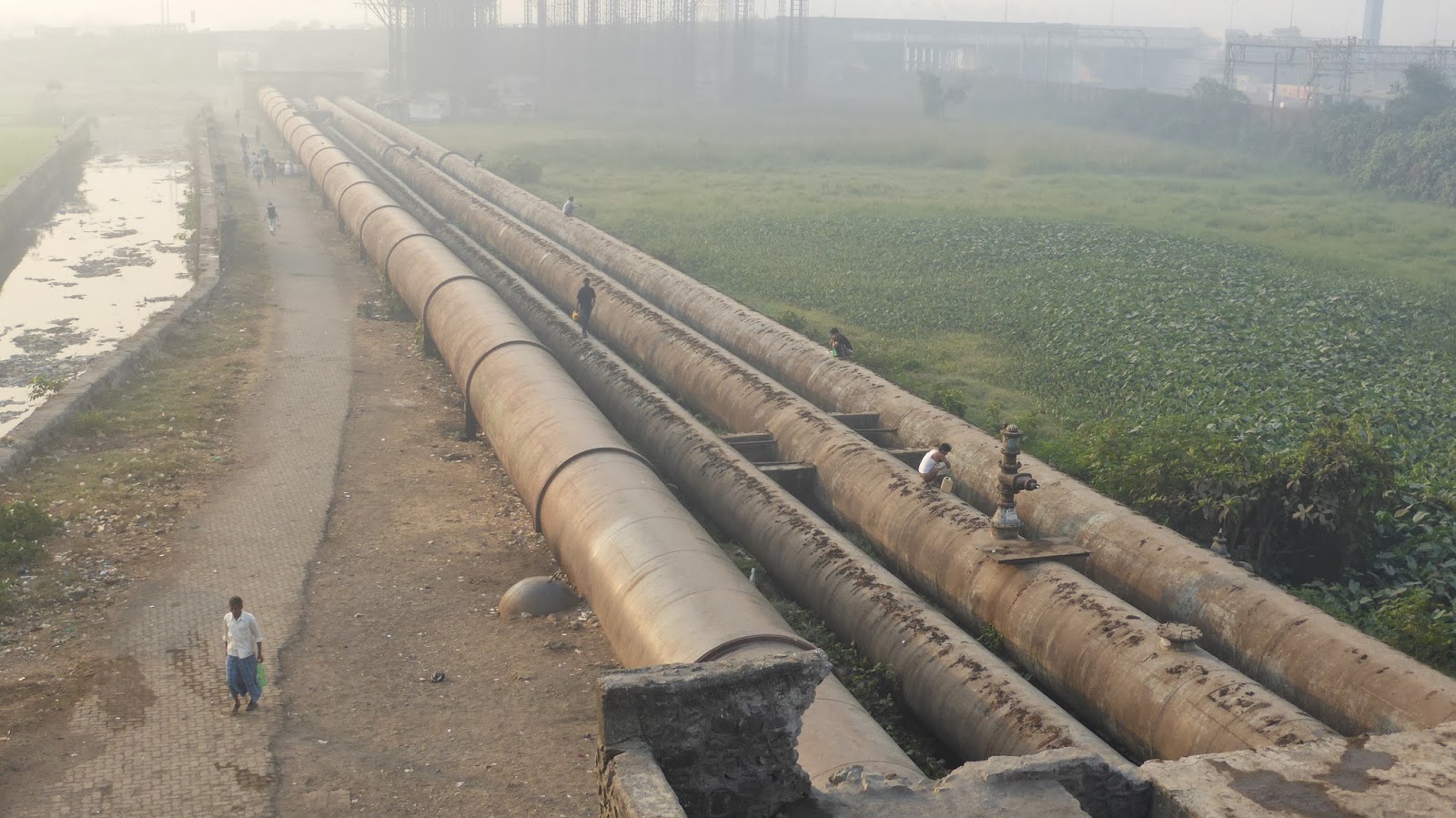
Locals hanging out by overland water pipes

Saturday, 1 February 2014

Slumdog Billionaire


In this blog: I see what the British left behind, visit the slums of Mumbai, and see the most expensive house in the world.

-----------------------------------------------------------------------------

6 months on the road... the route so far. Large map here

So first of all, a brief side note in that my arrival in Mumbai marked six months on the road. I'd like to say it's been awful, terrible, the worst experience of my life. But obviously I can't. I'm thoroughly enjoying the amazing experiences, unique sights and various wonderful people I meet, all often at unexpected moments. Sure, occasionally it feels a bit pointless, and making every decision on your own can be a bit draining, but it's all character building. I've learnt a lot about the countries and places I've been to, as well as assorted history I probably should have learnt at school, and have a broader understanding of the rights and wrongs of the world. And it goes without saying it's been a lot of fun! India itself has been a surprise as well; much more tolerable than expected, and full of excitement, chaos, and life. In fact the two months I expected to spend here have long come and gone, and I'll be here at least another month.

It's been a rollercoaster - but a good one - lots of excitement with the odd moment of feeling sick.

-----------------------------------------------------------------------------

I'd been a bit apprehensive about visiting Mumbai, but it took a while to actually realise this until I realise I'd been putting off visiting. I wanted to go but at the same time I didn't, I guess I had preconceptions that it was a huge overcrowded city, gridlocked, full of slums, dirty, noisy and unpleasant. In fact, it had elements of all of the above, but is overwhelmingly a modern, clean and developed metropolis and the source of half of India's tax income thanks to being the finance centre. In fact it turned out to be quite an endearing place, and I ended up quite liking it.

I arrived in the city mid-morning on a sleeper bus though can't say I was able to sleep a lot, and experienced straight-off the gridlock I'd heard about. Like Manhattan, a lot of the city is built on a peninsula, with too many people and cars in too small an area, and also like Manhatten were the hundreds of skyscrapers present, often surprisingly modern. Contrasting with this, the mass slums in various areas were also very apparent. It struck me straight away I was about to experience a very different India. 

The commuter trains at a quieter time of day
It was a lovely warm morning thanks to being much further south, and with the bus stopping far uptown, I took the urban train further south to the affluent Colaba district, witnessing packed commuter trains travelling with people hanging out of the wide doors that are left open all the time, a striking sight that took me back to Slumdog Millionaire which was filmed here. Partly thanks to people falling out said doors, Mumbai rail is the most dangerous in the world with a shocking 2,700 people dying every year - nearly ten every day. Property prices, and therefore accommodation prices are high in Mumbai, so once in the Colaba area I ended up taking a tiny windowless room on a fifth floor backstreet building, which sounds grim but was actually very clean and tidy so I didn't mind too much. Except for the urinal blocks they liked to put in the communal bathroom sinks to keep them fresh, which made me want to vomit every time I brushed my teeth. What a strange idea.

---

I went for a stroll round the local area, which was cleaner, much less chaotic and generally more 'normal' than I've been used to of late - one of the most obvious differences being that there were actually pavements to walk on. Oh the little things. I reached the waterfront and saw the Arabian Sea for the first time, a refreshing feeling when you've not seen the sea for a good couple of months. A shoeless child of about seven followed me along the waterfront begging for money, the most persistent I've yet encountered - but as mentioned before it's not wise to give to them, cruel as it sounds, as it encourages dependency on begging, and often the money goes straight to discretly-hidden gang leaders instead of the kids anyway I understand. I passed India gate, an arched monument built by the British long ago, and beside this, the luxurious Taj Mahal Hotel where the devastating Mumbai terrorist attacks happened in 2008. I stopped nearby and tried a Kulfi Falooda - a desert of a soft dough with almonds and cherry, drizzled in pomegranate seeds and milk, pretty nice. 

British colonial architecture - the high court
Mumbai, or Bombay as it was then, was very important to the British back in the day and consequently retains a lot of relics from the Raj era. I walked to the district known as Fort, passing cricket pitches, grand museums and art galleries, the university, cathedral, fountains, parks, and the old city hall. All of these were crafted from local stone in a hybrid of British and Indian styles, but looked unmistakably British in origin. 

That night I met up with Shaun, an Australian who I'd been hanging around with a month or so before in the North Indian town of Rishikesh. We'd got on well and stayed in touch, and fortunately our travelling plans coincided in Mumbai, and so began a few evenings of beer and banter, starting at Leopolds, a place I discovered the next day was one of the other locations of the Mumbai terrorist attacks, oh joy. Lightning never strikes twice in the same place though, or so I hoped. Shaun is a long-term traveller of about eighteen months, and supports himself by doing copywriting for businesses and websites based back in Oz - he can work anywhere in the world as long as he has an internet connection, a dream job some would say.

---

Thursday 16th Jan

Victoria station
The next day I took one of the old and characterful Mumbai cabs uptown, and set off around another part of the city. There were more relics of the British Raj - the rather grand Victoria Station which was more like a cathedral inside, some government buildings, the Central Post Office, and Crawford market. The latter was huge, and the speciality here seemed to be pet shops, where cages were stuffed often uncomfortably full of rats, mice, pigeons, cats, dogs, gerbils and brightly coloured birds. Not all together I must add, though that would be quite exciting to see. 

Further up the peninsula, I stopped as I walked past a university which was having some sort of games afternoon, and smiled whilst watching them do a tug-of-war competition in, of course a very Indian way. I spent the rest of the late afternoon at Chowpatty beach. It was a surprisingly impressive clean and pleasant stretch of sand, bang in the heart of the city, and was the perfect place to be in the late afternoon sun. Women sat on the sand in saaris and burkas, whilst chai-wallahs walked by carrying kettles continuously chanting 'chai, chai, chai' to the obviously tea-starved public. Not even tea-mad England has a cuppa on the beach.


Chowpatty beach

Mumbai is the home of Bollywood - the Indian film industry, and so there's cinemas everywhere. That evening, with not much nightlife going on locally, me and Shaun went to see Grudge Match, starring Robert de Niro and Sly Stallone, which in fact was American. The first surprise was to find that when you ordered food beforehand, they delivered it to your seat during the film. A great touch. The next was having to stand, along with the rest of the audience at the start, for the Indian National anthem which I decided wouldn't win any awards for catchiness. The cinema itself was fantastic, with a quality of picture and comfort of seat better than anything at home. Interestingly, despite being an American film with the dialogue in English, which many middle and upper-class Indians speak as a first language, it was also subtitled... in English! I guess some find the American accent unclear. Half-way through, the film abruptly stopped, and it was soon apparent it was for an interval. So old-school, I love it. It's funny how something as simple as going to the cinema can be so subtly so different in another country.

---

Friday 17th January
Mumbai is sadly associated all over the world with it's slums, and the British-Indian movie Slumdog Mlllionaire gave us all an insight into what they were like. However, like many movies this portrayal was a little skewed as I've since found out. 

Dharavi Slum from the railway station
About half the population of Mumbai live on just 6% of the land in such slums, and Dharavi, filming location of said movie, is the largest. In fact it's the second largest slum in Asia. When I first heard a while back that companies do tours of the slums for tourists, I thought it sounded pretty low - turning people's misery into an almost circus-freak-show type attraction. When I looked deeper though, I learnt the company doing the tours aimed to build awareness of the reality of the conditions, gave eighty percent of the profits to community initiatives in the slum, and don't allow photography. It then sounded a bit more dignified and respectful, so inteagued, I decided to go along on one of the tours of Dharavi.

On the half-hour train journey there, I was surprised to see an Indian ladyboy (news to me) poncing around the carriage making strange sounds, then touching people on the shoulder and demanding money, followed by supposedly 'cursing' them if they didn't oblige. Fortunately I was out of range, but it was a peculiar sight to witness. Our tour group arrived at the station right beside the slum, and the thirty-odd people split into groups of seven. Our guide was a local chap and was very good at what he does. He was keen to emphasise that the aforementioned movie portrayed and exaggerated the bad sides of the slum, without pointing out the good sides. Good sides I thought? He led us into the nearest area, where the main business is recycling. All sorts of stuff is recycled, and is mostly done painstainingly and dangerously by hand. Plastic, paint tins, and drugs containers, all ripped apart manually without any safety equipment, and processed by cleaning out, burning off, dousing in chemicals etc, before putting through small electric-powered shredders and crushers, made in the slum. Some of the waste is from India, and some from abroad I understand. After all, those container ships bringing shiny goods from India to Europe can't go back empty, so why not pass our waste onto more desperate and less safety conscious people to deal with eh? The sad way the world works unfortunately, and we're all part of that chain whether we like it or not. You have to admire their ingenuity in making money from nothing, but the conditions these people were working in were pretty dismal. They seem to be tolerated out of a combination of desperation, and the lack of knowing the real consequences, earning each of them between £1.50 - £2 a day (150 - 200 rupees).

---

Further on we came across some sewing workshops, where groups of about ten men sat in neatly laid out rooms making shirts. To be fair they looked reasonably content and the conditions didn't appear too bad. A lot was for the local Indian market, though the guide said some items were for Lee Cooper, via a middle man of course. The way that game often works. The surprise was that far from the local population wallowing round in piles of dirt and faeces, the paths round the slum were mostly concreted, everyone had a legal electric and water supply (I say legal - people used to tap in and steal it), there was a market, shoe shops, pharmacy, restaurant, hotel and butchers. We continued into this maze, past a guy being given a cut-throat shave whilst sat on a barrel, then some kids playing on the ground with medical waste. 

We were led into the very densely packed residential area, down very dark and narrow paths past houses, ducking below sagging overhead cables, and being careful not to get lost. The houses were almost all brick-built rather than tin shacks, and families mostly lived in single room homes about the same size as the average bathroom at home. Whilst it was obviously a completely inadequate standard of living in this day and age, at least they appeared to live with at least some dignity. The government are slowly doing something about it, bulldozing some areas and rehousing people in tower blocks, though not nearly fast enough. We continued on, looking in a small leather processing factory, watching women making pappadums on baskets laid on the street, kids playing cricket on the edge of a rubbish tip, and a very dirty looking river. We stopped at a community centre and saw the projects the charity was funding and organising which were all very positive.

It was a fascinating tour, though the whole way round I felt as if we shouldn't be there. We were obviously just generally interested, but it felt like they saw us as the rich people looking down our noses. That said, everyone was either friendly or indifferent towards us, so maybe this is just my imagination. Instead of coming away feeling a sense of despair, I saw a real sense of community, people working hard to better themselves, better sanitation than I imagined, and a good basic level of infrastructure. Yes, it all looks a bit inhumane to an outsider, but if you don't know any different do you see it as bad, or just normal?


---


Antilla - a house in the shape of a tower block
Once the tour had finished, I left the group and in a complete contrast to what I'd just seen, caught the commuter train a few miles south, and walked to a very posh part of town to see Antilla. Worth over US $1bn, Antilla is the most expensive private residence in the world, and owned by the richest man in India. It's hard to believe the two areas I'd visited that day are so close, but such is the diversity of India. Built in 2009, it's been controversial ever since completion, with some saying it's an icon of the city and an inspiration for people to work hard and dream big - 'look what you could achieve'. Others say it's disgusting, and completely insensitive to build such a place when so many people live in such squalid conditions, and I tend to agree with the latter. The easterly windows even look out over Dharavi slum just a few miles away. The whole area was a surprising contrast to the previous two months of India, with Mercs, Golfs, Skodas, Hondas and Beemers cruising around, big posh houses and trees overhanging tidy streets, and I really questioned if I was still in the same country. 

Mumbai was a happening place, so more tales follow in a day or two. 


The chaos around Crawford market. The guy with the basket is a freelance delivery man, India's version of FedEx maybe?
Traditional Mumbai taxis
Crawford market
Pull!