Rantepao, Sulawesi island, Indonesia (map)
In this blog: a huge water buffalo market, a cave graveyard, being invited into a wedding, and buffalo fighting
In this blog: a huge water buffalo market, a cave graveyard, being invited into a wedding, and buffalo fighting
-------------------------------------------------------------


Wedding bells


Tana Toraja is a region in Indonesia that's home to an ethnic group known as the Torajans, who have some very unique traditions and possibly the most elaborate funeral ceremonies in the world. This follows part one and is equally morbid, so I suggest you read that first to understand what this strange ol' place is all about.
Rene and I with a mega-expensive and rare Albino water
buffalo, prized by the Torajan people
Market Day
Gustine is a local Torajan girl who my travel buddy Canadian Rene had bumped into on our first day in Rantepao - a 21 year old studying for a degree in English, and as I'd helped her out by teaching an English class to some local kids, she offered to take us around the local area the following day, starting at the local market.
The market happens every six days and is a big deal in the area, with locals sat cross legged on the streets selling everything from vegetables and dried fish to hand made machetes, but in a large dirt area at one end was where the real action happened - the water buffalo market. Buffalos are a status symbol to Torajan people just like a BMW might be to some, and are very well kept - you see people in the countryside leading them round individually to grass, and I even saw one guy hand feeding his buffalo like a baby one day! Strangely because of the status, in total contrast to the 'real world' their live market value is actually greater than the meat value afterwards. The best cattle are sourced from all corners of Indonesia and the best of the best are black and white albinos. I'd never seen albino cattle before so it was a truly fascinating sight, with their pink and white colouring and piercing white and blue eyes.
---
Gustine translated and asked prices for us and I was truly amazed - £635 buys you a fairly standard male, £750 a medium sized shorthorn, £5000 for a pure albino, and unbelievably for a top flight part-albino a guy was asking £30,000! I checked three times with him, and even wrote it down and made him check again but it was no lie. There was no auction though, everything gets sold privately for cash which can be a lot of paper when you consider than the equivalent of the £5 note is the biggest in circulation in Indonesia! Interestingly, despite there being hundreds of buffalo present only a few of them actually get sold on a market day; the rest go back to their 5-star farm treatment. I wondered if their cattle beds have Egyptian cotton sheets? We spent a fascinating hour wandering about, looking at the farmers stood around in their flip flops smoking away and chatting, with their cattle haltered from above by rope through their noses.
Nearby was the much smaller pig market where we found two bizarre and slightly shocking things. Firstly we came across people stuffing sold pigs head first into plastic feed bags like shopping at a supermarket, Gustine could give us no answer why. Secondly, we found pigs tied individually to bamboo racks, just like a wooden pallet for a pile of boxes. It transpired this is to allow people to take them home on the back of their motorbikes - a sight in itself. Pigs were more sensibly priced generally at £150 for a hog, £100 a sow (in case anyone cares). Gustine then took us through the fish market which had a few sights and we were encouraged to pick up an eel from a bucket - a local speciality that are apparently often kept in the water of rice paddy fields. With their slippery skin and snake-like movements which I can't say I'm a fan of them, yet low and behold ten minutes later we were eating it for lunch at Gustine's mother's nearby cafe! It wasn't a taste I favoured I must admit.
---
In the country
After the market we went out in the countryside to explore. The whole local area is just beautiful, and everywhere you go you see the remarkable sight of 'tongkonan' houses - traditionally made wooden homes, stood on palm tree legs, with carved sides and huge bamboo (or just steel) roofs in the shape of a boat. These buildings can only be built by the family and passed down, never bought or sold, and are phenomenally expensive to construct. They're also always accompanied with one or more rice barns nearby - a smaller version where the rice harvests are kept.
I had a map of the area and pointed out a few things that might be of interest so Gustine led the way, the first of which took some finding and involved a lot of asking locals and getting lost. We parked up in a hilly area far from town and learnt we were the first tourists of the year to visit this spot. Two local teenagers volunteered to lead us for free, hiking a short way along a path and up a hill to a traditional burial site - a huge natural rock with three graves carved into it in the traditional manner. Interestingly, a fairly new wooden coffin, cotton-clad and containing a body was left on the floor outside 'because there was no space inside', and when I asked what might happen to it Gustine said 'oh, it'll probably just stay there'. OK! After a few minutes of following blindly up steep overgrown paths, we reached a lovely viewpoint with a view for miles over rice fields, mountains and the nearby town.
---
Scream
The next stop a few miles away was quite literally something else; the sort stuff of stuff you might see in old horror movies.
Gustine, in conversation with locals heard of a traditional sight well off the tourist map and we turned into a side road and parked up. We walked half a mile or so up a track, past traditional homes, through someone's yard then onto another narrow path until we reached some old gates. This we discovered was a very old burial area set in the large entrance to a cave, where coffins were either placed on the ground or originally suspended from the cliff faces by wooden supports since rotted and collapsed, and we spent half an hour or so looking around. Everywhere you looked there were these beautifully carved but broken and rotten old coffins, many carved from one piece of wood and some with buffalo heads carved into one end. But more prominent than this were the hundreds of human skulls lying around. Some resting on the ground, some on rock ledges, some in open coffins where whole families had been buried together, and others in smaller caves. This might all seem a bit weird and disrespectful but in Tana Toraja this is their tradition and perfectly normal, and it occurred to me that it's funny how travel makes you adapt to such things so quickly, almost desensitising you.
The cave graveyard
Wedding bells
Since she had a week off from college with nothing planned, Gustine had now become both our local friend and a free guide of sorts (to the annoyance of the pushy guides who frequented our guesthouse). She told us of that whilst she was born locally, she's lived for the past nine years with her uncle in Papua - the Indonesian part of Papa New Guinea and returning only recently, so was therefore pleased to be exploring the local area herself properly for the first time. She showed up around 10am the next morning with a male friend of hers from uni who's name I forget, and we all headed off to explore the area north of Rantepao.
Passing through a small village on the way I heard loud music and saw something happening so beeped to the guys in front to stop. 'It's a traditional Toraja wedding' they said, so I suggested we turned back and had a quick look through the entrance. We took a couple of photos then to our surprise the usher invited us in. We politely turned the offer down as it felt like gatecrashing but he was insistent, so before we knew it we were sat there in our scruffy clothes in a small booth surrounding the nicely decorated outdoor courtyard, eating snacks and wondering what on earth just happened.
---
The couple weren't yet present - it was a Christian wedding and they were at the church with close family sealing the deal, but villagers and friends slowly made their way in. I couldn't get over how well presented it all was and how immaculately everyone was dressed, wearing a mixture of modern suits and colourful traditional clothing. After maybe an hour the couple arrived, and led by maybe twenty young boys and girls in matching Torajan outfits walked in a procession down a red carpet then up to their throne; the top table of sorts with their parents sat to each side. A preacher gave a short speech and the register was signed before food was distributed, and despite our hesitation at the generosity were told we must eat - the sate pork was absolutely delicious.
Surprisingly, after the couple had been there just an hour or so to our surprise it was all over. The guests formed a line and took it in turns to shake the happy couples' hands and leave. We still felt like gatecrashers but they seemed very happy to see us, to the point that Rene and I even got in the official photos with them! It was a great surprise and privilege to be part of the event, and the value of such authentic real-life experiences was only cemented in our minds when we headed to a nearby traditional village afterwards. It was more of a tacky outdoor museum than the real lives we'd just seen, and it the amount of tourists that visited had turned the locals into pushy hawkers trying to flog souvenirs so we didn't hang around long.
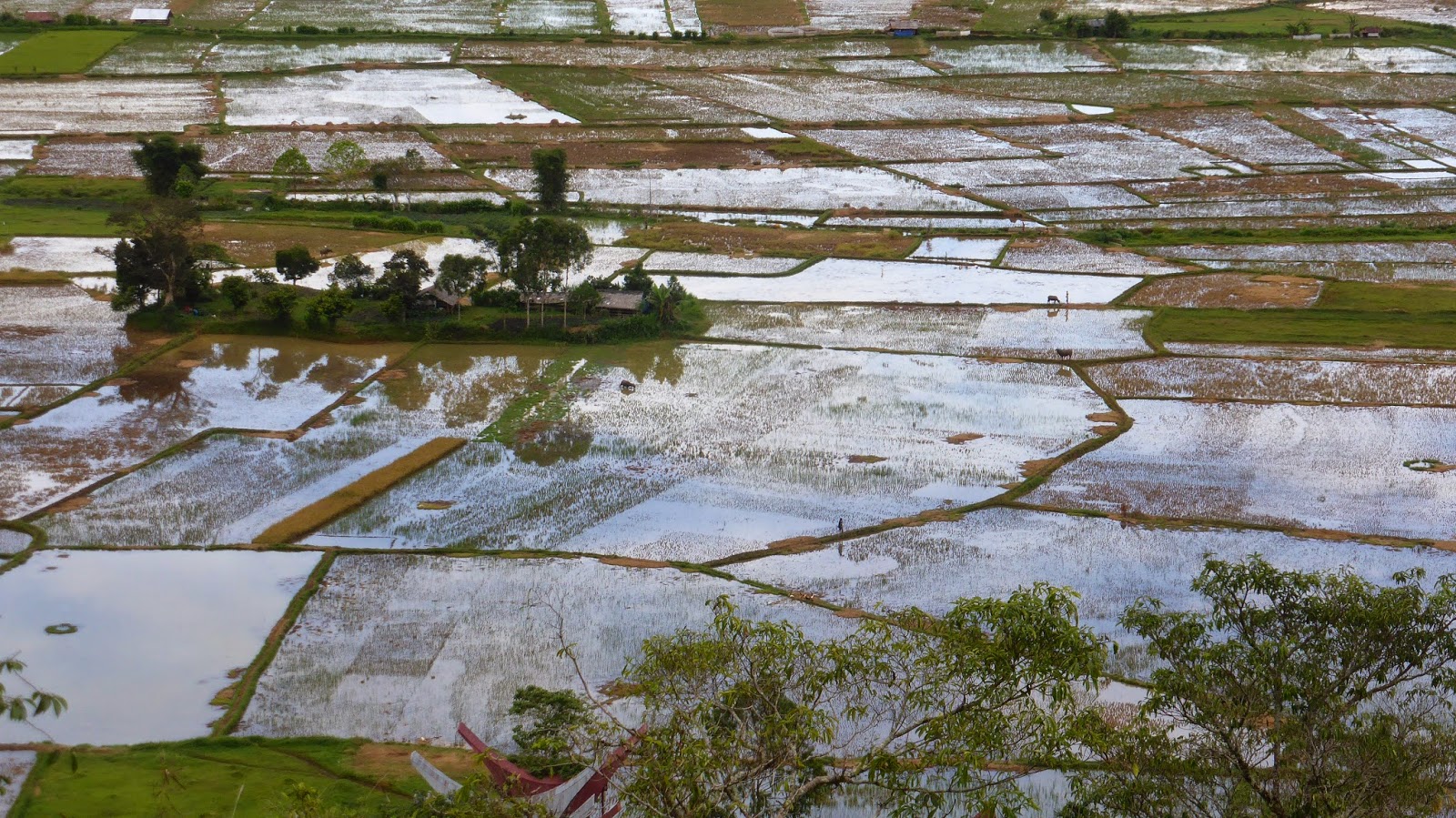
A few miles later the scooter got a puncture. We were in the middle of nowhere and the feeling of isolation struck immediately. But almost straight away a truck slowed and shouted out the window to Gustine, and to our total surprise we found there was a little shack just around the corner that did repairs. Even more surprising was that the guy got onto it straight away, stripping down the back end of the bike to remove the wheel and tyre and fit a new tube. Just £2 worse off, we were soon on our way feeling amazed at how quickly a big issue can be solved sometimes. We headed up into the mountains for an hour or so over bumpy tarmac and sometimes muddy bits of track, passing through more small villages and roadside graves carved into giant rocks. The best part lay further ahead though when the trees cleared beside the road and revealed huge sections of rice terraces built into the hill. It was the stuff of postcards apart from the fact it was raining, and I was a little awestruck by the sight of the hundreds of different levels of paddy fields.
 |
| The Torajan wedding we attended, surrounded by traditional rice barns |
Buffalo Fighting
Gustine had been told through friends of her parents of a local buffalo fight going on one day; another part of the intricate funeral ceremonies the Torajans have, and she lead us there by scooter. Arriving quite early, the locals welcomed us into the courtyard at the centre of events and we sat under one of the many traditional rice barns, watching pork being boiled in huge vats for lunch. We'd visited a buffalo fight at a couple of days before but the fighting had finished just as we arrived, which now made this the third funeral ceremony we'd visited in as many days!
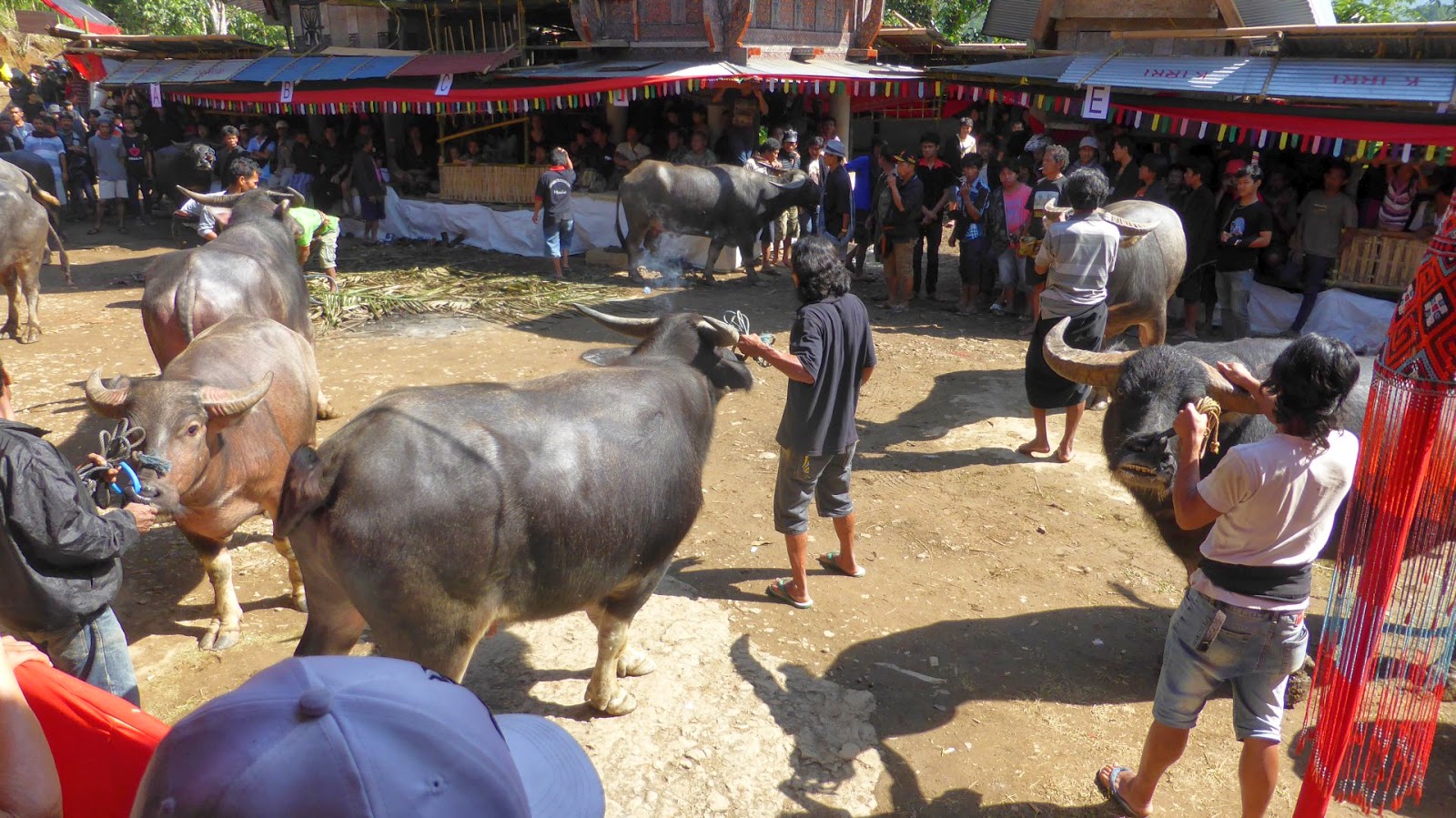
The proceedings started with the fighting buffalo being led in to the main courtyard for people to see, haltered by rope throes the nose and controlled by what we presumed was their owners. One buffalo looked very angry as it passed us, and a local laughed when he saw tears running down it's cheeks - I think I'd cry if someone did that to me too! A traditional priest sang and chanted for quite a while in a near evangelical manner over the PA, in a special language not even the locals understood, and Gustine noted that the old guys near us were moaning that they were bored. With music playing, a long line of ladies next entered the courtyard, holding a long narrow piece of red cloth above their heads in the manner of a Chinese dragon, and danced slowly along for a few minutes to music, and at this point I suddenly realised what a unique and special event we were witnessing. Everyone present including family, friends, villagers and guests like us then got fed a fairly simple meal of rice, beans and the boiled pork we saw earlier, though the pork unfortunately turned out to be mostly fat and gristle. Gallons of strong home-made rice wine were then passed around to wash it all down, a bit of an acquired taste I decided after a couple of sips.
---
Fight time
An area below roughly the size of a five-a-side pitch had been prepared nearby for the buffalo fighting, and the crowd gathered round on all sides mostly unprotected from the 'contestants'. Owners led their buffalo in from both ends of the arena and simply let go of the haters and walked away. The buffalo usually then just stood there for a few moments, slowly gazing around at the crowd and wondering what was going on before eye contact was eventually made, some sniffing happened and they moved closer. Suddenly horns would lock together and the action began. The crowd started cheering, bets were made, and the buffalo went head to head forcing the other into the ground. Eventually one would break away and run off out of the arena, the crowd desperately jumping out the way whilst the cattle sprinted down the road or into the woods out of sight, and the one chasing would be proclaimed the winner. In one particular contest things moved very slowly and with nothing happening for a few minutes the owner went behind his buffalo, and square between the legs kicked his buffalo in the testicles with his bare feet! Brave but stupid, yet had the desired effect. It was all good fun to watch, and unlike the brutal sacrifice I'd seen a few days before there was no real harm done as far as I was concerned.
As if we hadn't seen enough already, later that afternoon we headed to Ke'te Kesu; a traditional village nearby to Rantepao town where we were staying, but in contrast to all the real-life-off-the-beaten-path sights we'd seen in the past few days, again it was touristy and soulless and just a bit disappointing to visit.
We ended up stayed in the Tana Toraja area a week since it was so beautiful and interesting, and the final day Gustine decided to meet us to see us off. I'm not exactly sure why, but dear of her, she cried as we got on the bus and headed off south to Makassar. We'd seen a fascinating culture with traditions seemingly well preserved on the whole despite the tourists who visit, had some free lunches (there IS such a thing), met some kind locals and seen some stunning countryside to boot. A perfect kind of travel experience.
Looking cosy on the scooter out and about in Rantepao
Market day in Rantepao
Local farmers at the market
Live pigs just sold at market, ready to take home by motorbike
View over paddy fields
 Eating lunch at the wedding with Gustine (R) and her friend |
 |
| Traditional Toraja village, even if this one had been a bit ruined by tourism |
 |
| Rice terraces up in the mountains |
 |
| Ceremony in a courtyard surrounded by rice barns before buffalo fighting |