Showing posts with label monkeys. Show all posts

Saturday, 26 April 2014

Big Nose Monkey

Baku National Park, Malaysian Borneo (map)

In this blog: a gentle jungle walk, rare monkeys and a whole load of insects.

---------------------------------------------------------------------------------------------

Proboscis monkey heading out for lunch


Borneo is known for it's jungles - one of the big draws for visiting - and the small National Park of Baku seemed like a nice gentle introduction to the wilderness, so since Christian, the German traveller I'd met in Kuching was heading there I thought I'd tag along. 

Despite it still being on the main island, there's only one way to enter Baku and that's by boat - a pleasant half hour journey up a river estuary then along the coast, a fun start. Being just an hour from the capital of Kuching the park is quite popular with tourists and therefore reasonably commercialised which kills the adventure a little - the paths even have distance markers every hundred metres - but it wasn't enough to ruin it. Christian and I set out straight away, walking a four mile loop through the trees, my first experience of proper tropical jungle. We crossed a wooden bridge with wild bearded pigs rummaging in the mudflats below, as well as a plethora of brightly coloured odd-looking mud crabs. The path through the jungle was well kept and very clear, but the vegetation dense, lush and exotic. The whole time I was spotting new and interesting things which were larger, more colourful, or more weirdly shaped than anything I'd seen before. It was however pretty humid though, which made it much harder work than normal over such a small distance.

---

Back at the park centre we sat down for a drink and a rest. Christian opened a can of Sprite and took a sip, and we watched a rehesus monkey rummaging around in the grass outside. It looked our way then away again, slowly walked towards the cafe, climbed a wall, and before we knew it grabbed the can of drink and quickly scurried away, leaving Christian a little dumbfounded and heading back to the fridge. The jungle in Baku is also home to the Proboscis monkey - found only in Borneo and very unique with it's big nose. We were fortunate enough at dusk to see them hanging out in the trees nearby, picking leaves and buds, swinging between trees and just hanging out, unphased by all the camera lenses around. Fantastic.

We went on an organised night walk that evening along wooden boardwalks, hoping to see a few animals, but were largely disappointed on that front instead coming across heaps of creepy crawlies - stick insects, millipedes, frogs, and some pretty large spiders. Seeing a circada hatching, leaving it's old skin on a tree before flying away was particularly good.

---

We went on an other jungle walk the following day, ending up at a small beach where we discovered we could climb the climb a little way up the cliffs and jump back into the deep water below; great fun. After a couple of hours of turning red, forgetting I was so close to the equator where the sun is strongest, I left Christian dozing in the shade and headed off alone a couple of miles further into the park, passing spiky-limbed palms, roots everywhere, peeling bark trees, before reaching a waterfall after an hour or so. The water below was a deep shade of black, surrounded by mossy rocks and even lusher vegetation than before. It was absolutely beautiful, reminding me of the movie Avatar, and a perfect place for a quick swim to cool down.

Some other folks we'd met at the hostel in Kuching showed up that night which was nice, though tainted by an rather odd short bald guy from Israel. This guy was something else, from the off argumentative, rude, annoying, arrogant, butting in constantly and very pedantic - it was hard to get rid of him. It was a shame as travellers I've met on this trip have been nice, but later all these character traits made sense. He was a lawyer. Still, it didn't ruin the experience, and Baku was the perfect introduction to wild Borneo.

Bearded wildboar

At Baku lookout


Proboscis monkey with its big ol' nose

Loop walk with Christian 


One of the best I've ever seen.


Night walk - huge spider


Night walk - tree frog


Hidden beach


Pool below the waterfalls

Friday, 4 April 2014

Bamboo Safari

Kumily, India (map)

In this blog: a great bus ride, a bad cycle, and a walk in the park - safari park.
----------------------------------------------------------------

Fighting monkeys

The answers rang off like an episode of Family Fortunes; with everyone answering with total conviction as if I was asking them the colour of the sky. There was no doubt in their voices, but total disparity between their answers. The question, a simple 'What time is the bus to a Kumily?':

Hotel manager: '2.20pm, but be there at 2'
Shopkeeper nearby: '2.20pm'
Rickshaw driver: '3.00pm'
Man waiting at bus stand: '3.20pm'
Another rickshaw driver: '3.30pm'
The bus driver himself: '3.45pm'

Total confusion as ever but fortunately waiting around for an hour or so wasn't a problem - you can only smile. To be fair, public transport in India generally isn't as bad as it may sound - it runs regularly and often leaves on time, despite the ever varying quality of buses, roads and driving. 

Leaving the tea town of Munnar, I took the local bus on the four hour journey south - the fare as ever, unimaginably cheap at just 87p (87 rupees). I sat next to a guy in his mid-twenties who couldn't speak English, but who upon seeing my camera whipped out his phone and proudly showed me grainy and blurry videos of landscapes that he'd filmed on his tiny phone, bless him. Later after a break a pleasant old guy, also with no English, offered me his seat by the window then some of his peanuts. The driver and conductor were also both very friendly and helpful guys, even saying hello out of the blue the next day when I passed them on the street. There's kindness on every journey in India. But the journey itself; well what can I say, except that it was one of the most beautiful I've ever been on. Winding for an hour or so through tea plantations in the mountains, with rocky summits above, then going along a high ridgeline where you could see over miles of rolling hills and forest, before dropping into valleys, passing through cardamon plantations and small villages. A lovely afternoon, made all the better by the  windowless buses they have in Kerala (except for the windscreen, that would be a bit suicidal). 

We arrived in the dark at Kumily, a small town on the edge of Periyar National Park. The town itself is nothing to write home about - for the most part a typically noisy, dirty and delapated Indian town, but the park itself is one of the biggest parks in the country and professionally run for once. After two other safaris elsewhere in India I thought I'd do the hatrick - following one in a jeep, and one on a bus, this time it was both on foot and floating about on a bamboo raft.

Ride to Nowhere
Kumily was said to be a nice area for a cycle, so the next day naturally I grasped the opportunity and hired a ride for the day, since it was too late to arrange any activities in the park that day. As with most bikes I've hired in India the first one was terrible, so much so that with the forks wobbling violently and brakes barely working, I took it back and got a refund before it killed me, finding something else mildly better nearby. Finding a map was equally difficult - nothing was sold, and the printer in the Internet cafe wasn't working, so I ended up taking a photo of the map on screen using my tablet, before eventually I was on the road.

Logging truck
I set off on an aimless cruise about, first reaching a pair of official looking gates, getting refused entry by the guard as it turned out to be a tribal settlement. I instead went down a dirt track to the side, eventually getting back on another road. The houses nor fences didn't seem the usual style and there were few cars or bikes around. I then had a suspicion I'd inadvertently gone into the settlement, but wasn't sure. I decided to keep going anyway, passing fairly simple concrete houses, fences made from woven branches, and some simple mud huts. After ten minutes or so I started passing people, getting more looks than usual before passing a building which clearly said 'tribal school' outside, confirming my thoughts. The people looked and dressed the same as any typical Indian, so I guess these had been re-homed from the national park voluntarily or otherwise, and adapted to modern life somewhat. I found my way out the other end  without any security dramas and continued on.

Normal when I cycle, an obvious loop presents itself but this time nothing seemed to flow. The turnings I needed to be able to make a loop didn't seem to exist, and after heading downhill a few miles I u-turned back to the start, before going up a steep hill a few miles, again finding no junctions and turning back the same way. The scenery was nice though, passing one spice garden after the next, a tea growing area, and a coffee plantation, before reaching a village in the hills where kids shouted and waved at me, with one group of young boys even trying to block the road to make me stop and talk. Despite being in the hills of the Western Ghat mountains where it's generally cooler, it was still darn hot so drained of energy, frustrated with the single-gear bike, and for once a bit bored, I headed back after a couple of hours and barely fifteen miles, instead going for a little stroll in the woods and reading a book instead. I'm not sure where anyone got the idea Kumily is good for cycling.

Periyar National Park
After a disappointing safari a couple of weeks before, I thought I'd have one last stab at seeing the wildlife of India. I set off on a nice dawn stroll, heading a couple of miles along the road into the national park towards the visitors centre, seeing just a small herd of wild Indian Bison on the way, in some open grassland. At the park centre our group met - an Indian couple, a lawyer from California, and a Korean girl; all nice people. Along with two guides and an armed guard in case of elephant attacks, we headed off into the forest. As dangerous as that sounds, the guard said he'd not had to fired a warning shot once in over ten years! For the first couple of hours the scenery changed immensely, going from evergreen forest, to teak plantation, to denser forest, to open grassland. Visitor numbers are tightly controlled in the park and in fact we were one of just a couple of groups that day, making it feel very natural. 

Malabar squirrel
The sound of crickets permeated the air throughout the day, but in one section they were overwhelmingly loud, to the point they almost hurt your ears; a football stadium of insects upset that we'd strayed onto their turf. The guides stopped and picked out various things along the way - termites decimating a branch, ants scrambling up a tree en-masse, a wild chicken rummaging in the undergrowth (they can fly properly you know), and niligiri langurs (monkeys) lazing in the trees. The guide held out his hand to us, indicating to stop, pointing high up in the trees to a Malabar squirrel - indigenous to the region and one of the worlds biggest, with a large bushy tail and a multi-coloured quilt of a coat. Quite a sight.

Rafting time
We stopped for the packed breakfast they'd issued (bread, bread, bread), before reaching the lake and starting the main part of the trip - bamboo rafting. The raft was fantastic - a home made beast made from huge pieces of bamboo tied together, with seats fashioned from smaller sections. The guides sat at the back doing most of the paddling, though we were handed a hand carved paddle each and encouraged to do our bit. The lake itself was built by the British in 1895 to supply water to towns in the neighbouring state of Tamil Nadu, and at this time of year the water level is pretty low, meaning you should easily be able to spot wild animals coming out of the forest to drink. Unfortunately we didn't. Despite being able to see miles of shoreline, all we managed to see was a couple of wildboar grazing. Oh well, nothing is guaranteed on a safari and that's half the excitement. All very relaxing though, slowly floating around in the sun.

We stopped for another hike in the forest. The guides pointed out a few trees, including the banyan - a parasite that climbs other trees, kills them and becomes the main tree itself. We saw huge climbers, the sort that Tarzan would swing on, some 8" or so in diameter, a curryleaf bush - a key part of Indian cooking, and a wild chilli bush - even spicier than the domestic chilli, as I found out after eating one. Tingly tongue would be an understatement. The guide scraped off some tree bark and held it to our noses - cinnamon it turned out, and picked a fruit from a bush which we tried - guava fruit. A little further on, excitingly a mongoose ran into site for a few seconds, but disappeared before we could really get a good glimpse. We returned to the shore where we left the boat, and the guys unfolded a big tarpaulin for us to lunch on. A snake wriggled it's way out, and headed towards the lake! It was only a small one, maybe an inch in diameter and a metre long, and was apparently a water snake, which would have climbed on board as we rafted. Reassuring! 

Indian elephant,and
sambar deer
Disappointingly we rafted back exactly the same way as before, but did manage to spot a white necked stork, egrets, some little cormorants, and a fish eagle - I write these names in ignorance, just reciting the guides' expert knowledge. Beautiful birds though. After another walk for an hour or so, we were back at the visitors centre. Despite being packed with noisy tourists, ironically we saw the most wildlife of all (secretly fed by staff for the benefit of tourists I wondered) - a pack of sambar deer, and a mother and baby wild elephant, grazing on the other side of the river - finally! Our group dispersed, and I started wandering back to the village, spotting some monkeys hanging out on a building site. I sat down and watched them for twenty minutes or so - lazing, fighting, hanging from trees, stealing crisps from passing children. Prime time entertainment. 

On the way back an Indian woman in her mid-twenties, walking along with her children, started talking to me. She was very friendly and chatty, and her husband and friends soon joined them - a group of sixteen of them on holiday together, having taken a thirty-eight hour train journey to get there! I got invited to have a tea with them, before finding the cafe was closed and saying goodbye. My point here is that it was the first time in over four months an Indian woman had initiated a proper conversation with me, after talking to hundreds of Indian men. It always appears to me to be be shyness, a lack of confidence, or domination by husbands. Or maybe I should start washing my clothes more often.

Niligiri langur (monkey)
Empty 'shells' of dead crickets

Raaaaaa! Bison skull

Our snake friend

Egrits and cormorants

South Indian 'thali' lunch - 45p for all this!

Friday, 20 December 2013

Think Differently


The end of the line was nearing on the overnight journey, so having managed to grab a few hours sleep I went and hung out the train door, taking in the scenery in the refreshing morning sun, passing people walking beside the tracks heading for work and pigs rummaging through rubbish, arriving eventually at the final destination - Rishikesh - a bit of a special town in different ways. I didn't know a lot about it, but it was recommended by a few people as being a bit of a travellers Mecca, as well as having some good hiking, being very new-agey and a big pilgrimage sight for Hindus; so all in all a pretty diverse place to visit. They were right, it's been interesting and thought provoking, peaceful and relaxing, fun and exciting, and led me to try a number of out-there things I'd never even thought about before, let alone tried. I ended up staying over a week which included among other things, another eventful hike, an offer of starring in a TV advert, yoga, lots of chai, and a run in with both some monkeys and a security guard. So it's fair to say it's been the most bizarre week of the trip so far.

Tuesday 10th 
I arrived in the suberb of Laxman Jhula at about 9am, and immediately settled straight into a different frame of mind; that where traveling is more about watching, talking, relaxing, learning, reading and trying, thanks to there being so many other backpackers around for once. I found a nice place for breakfast beside the famous holy river Ganges, and had a bowl of porridge with chopped banana and honey, a new favourite of mine - not exactly typical Indian food, but then this is no typical town. There's so much accommodation and therefore competition available in the town, that I soon found a hotel with a decent but basic double room overlooking the Ganges, set back against the wooded hillside, for an unbelievable £2.50 (250 rupees) a night! A whole en-suite room with balcony, hot water (not always included) and WiFi to myself for that price - how is this even possible?!

One of the larger ashrams


After a morning catching up with a few things I set off to look around town, and was instantly captured by the calm and reflective mood of the place. I was surprising to see how clean the Ganges looked, roaring past in a deep shade of turquoise ready for people to pollute it further downstream. Hindus consider the river holy, and throughout the town you see many hanging out on the ghats - sets of wide steps down to the river, bathing in this 'holy water' and filling small containers to take home. As far as foreigners go, the town seemed to be dominated by hippies - I've never seen so many. Some in the stereotypical brightly patterned clothing with dreadlocks, some in traditional loose fitting Indian plain white cotton gowns, and a few in orange Hindu robes, strolling around often looking a bit spaced out. The town seemed to be dominated by various Hindu temples, ghats and Ashrams - walled complexes where mostly Westerners come on intense ten day Yoga and meditation retreats, where they hope for some sort of enlightening spiritual experience. I strolled through the well-kept public areas of a couple of these compounds, seeing statues of Hindu gods, manicured gardens, people sat meditating, and locals chatting. 


Local saddhus

Inside an ashram complex

Wednesday 11th
It's certainly not something I'd normally consider doing - I mean Yoga is this eighties fad which girls use for fitness and toning, isn't it? In India it's considered very differently, and practiced equally between sexes without stigma. So whilst in the 'yoga capital of the world' and always open to new and interesting experiences, I gave it a go to see what it was about.

I was the only person at the beginners class at 'Om Shanti Om' and it was just as well as it would have been hilarious for anyone watching. I mean I could barely cross my legs - the last time I remember really doing so for more than a few minutes was at primary school! The lady first taught breathing exercises designed to relax the mind, then gentle stretching exercises, building up over the hour to some of the set moves. Surprisingly, doing the session made me realise that last year the coach at my gig rowing club at home sneaked some yoga exercise into our fitness training without us realising, cheeky. My back ached, my hip joints hurt, and I had no flexibility at all, but I left at the end walking very upright and feeling extremely relaxed.

I spent most of the afternoon in one of the many cafés in town catering to backpackers, most of them following a similar theme of beach hut type decor, alternate music, free WiFi, and offering a variety of worldwide food. Not exactly authentic Indian obviously, but great places to spend hours relaxing, reading and meeting other travellers, and I chatted for a couple of hours to an Australian lad called Shaun who I ended up hanging out with a few times over the week. Strangely, I think he's the only other long term traveller I've met on this trip until now, him having been away well over a year so we shared a few stories from our trips.

That night I went for tea, and a couple of minutes after sitting down the waiter said 'that guy over there would like to speak to you', pointing to a business-like Indian guy. Intrigued, I went over and he introduced himself as a casting agent who had been working in town on a German movie that had been filmed here the past few days (I'd spotted them earlier), and said he was now casting for a project next week which he thought I looked suitable for! I couldn't help but laugh. He said 'Would you be interested in in starring in a paint advert, you'd only have a few lines to say and we'd pay you, as well as your expenses to get to Kerala (south India) and stay'. He took a photo of me on his phone and sent it to the director, who immediately replied saying 'send more pictures' which he did. I was told to wait and see for a couple of days...

Statue of one of the Hindu gods

Thursday 12th
I was reading my book on the roof terrace area of the hotel by my room that morning, when I spotted a group of about eight monkeys congregating, first on the area down below, tearing apart a bin bag scattering it everywhere and scavenging for food, then being shooed away by the guy on the room above. So when one of them started moving towards the bin near where I was sitting, for some reason I went towards it waving my arms, and shouting to usher it away. Bad move. It stood upright with teeth snarling and started running towards me. I panicked, not really knowing what was happening or what to do so I just shouted at it and started running. Thankfully some Indian guys close by heard the commotion, and chased the whole group off with a stick, so all was ended up fine. Slightly terrifying, especially as they're sometime known to bite, and can carry rabies. I really should have known better!

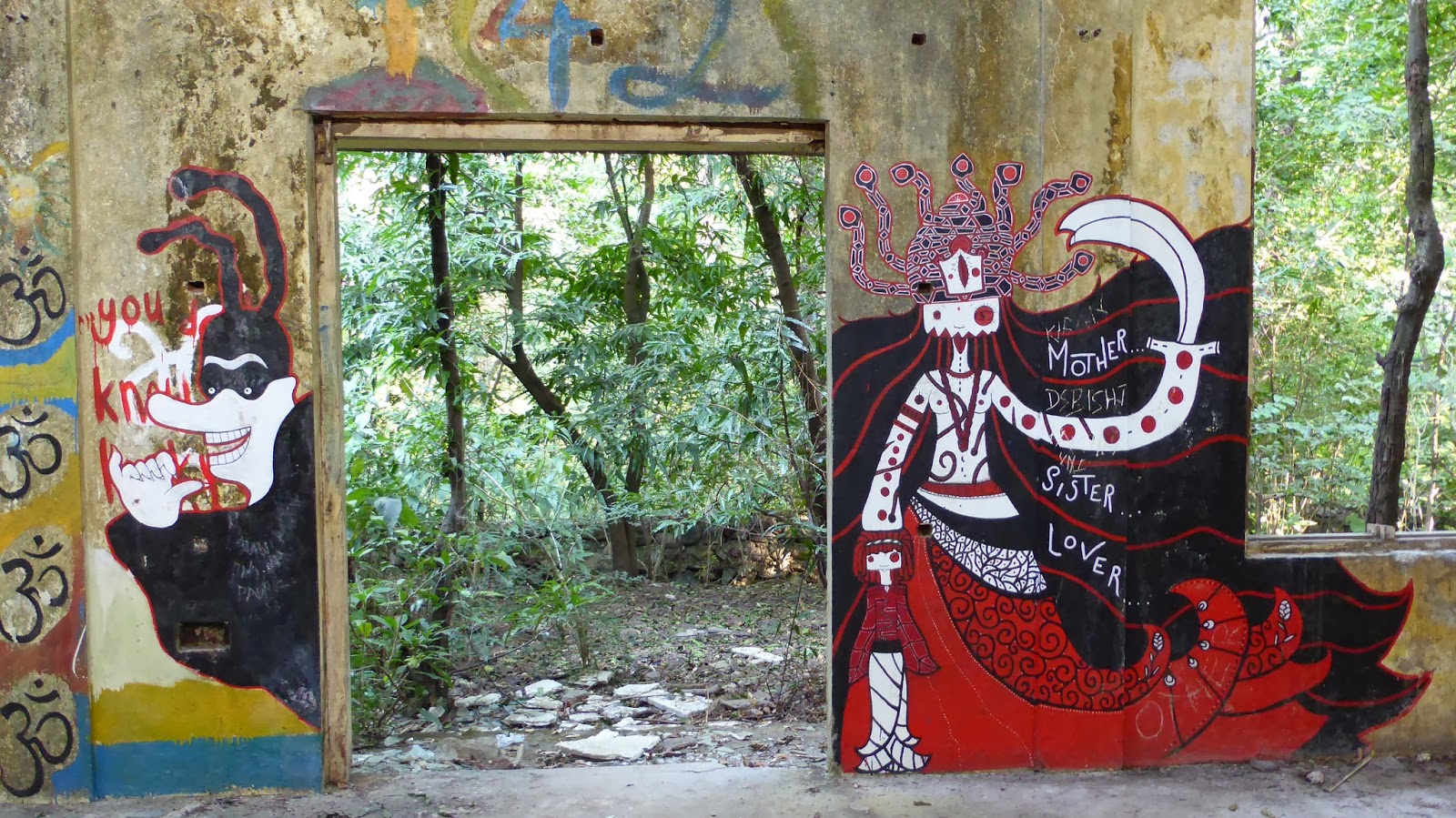
And so from monkeys to Beetles. Back in the sixties, the pop group The Beetles famously went to India for a couple of months inspired by a Hindu guru they met in England, and stayed in his ashram here in Rishikesh, supposedly doing spiritual stuff but in reality doing a lot of drugs and writing songs, including the whole of The White Album. The place they stayed at, for various reasons closed down long ago, and when the lease ran out in 1997 was abandoned and left for nature to reclaim. I'd read and heard a lot of different stories about how fantastic it was, and despite being officially closed and fenced off, how lots of people just bribe the guard or jump the wall around the side. Not the sort of thing I'd normally do, but I figured if so many people were visiting and doing no harm, one more wouldn't hurt. Even my Rough Guide book hinted it would be fine. It sounded well worth a chance so I walked to the outskirts of town, and after asking around a bit found the place. Following the wall of the complex around through the woods, out of sight I climbed a crumbled down half meter high section where other people had obviously done the same. Inside I was instantly enthralled - all of the original paths and buildings remained, although stripped completely back to their concrete bones, and were completely entangled with trees and bushes that had grown over the past couple of decades, reminding me of the lost temples of Anchor Wat in Cambodia. I walked around looking in the meditation huts, into the old accommodation blocks, kitchens and various other outlying buildings, trying to work out what their purpose may have been, and which buildings The Beetles themselves would have stayed in. I imagined the place full of life, and wondered how such beautiful buildings could just have been abandoned like this, now rotting, rusting, peeling, broken, fallen and decayed. 

Former medidation huts

On the rooftop, with mosaic clad domes

It was so quiet, the only sound being the Ganges flowing nearby and a dog barking far away in the distance, and I stepped into the large hall where the Maharishi - the guru - would have given his lectures, now with walls covered inside by some great artwork and inspiring quotes. I then went up a concrete staircase onto the rooftop patio of one of the nearby accommodation blocks, and found a couple of American guys there so chatted away for a few minutes. A local sadhu (wandering monk) arrived a few minutes later and waved his stick ushering us out though not in a threatening manner, and we thought we'd better oblige. Down on the main path, we came across about six other people who had also been looking round and 'caught', standing solemnly by the security guard. Busted. He marched us out and that was that, a couple of hours in an amazing place with a lot of history. OK so strictly speaking I shouldn't have been in there, but from what I understand half the visitors to Rishikesh seem to end up visiting at some point so they can't be too worried. I'm not sure if it's a shame it's not officially open, or more exciting because of it. 

Inside the main hall 

Friday 13th
'Excuse me sir, I am schizophrenic, give me money' - one of the more imaginative lines I've heard from a beggar, as I walked to breakfast that morning - it's a complicated and widespread issue in India and I'll discuss it in a separate blog sometime, but in this case I rightly or wrongly put him down as a chancer and walked on.

Apart from hanging out in some cafés and reading, my only proper activity this day was something I never thought I'd do. Now I'm pretty skeptical generally of a lot of the new age practices you hear about; I guess I'm just a bit scientifically minded. But I'm also of the belief that you shouldn't dismiss things without trying them, so out of curiosity I decided to go and get my palm read at one of the many places in town. It lasted about quarter of an hour, with an old Indian guy carefully examining both palms with a magnifying glass, telling me things as he went. I won't tell you the results, but all I will say is that I left as skeptical as I arrived. It was all positive, and a couple of things were interesting (let's see if they come true) but I can't help but think a lot of it was generalisations he could have applied to anyone my age by just looking at them and picking out the obvious. 

I met up with Shaun again that night as well as Emilie - a French-Canadian friend of his and went to East-West, a very relaxed restaurant that turned out to be a proper hippie hangout, and the only happening place to go in town of an evening. Being a holy city, Rishikesh is completely dry - alcohol is illegal in town, and I looked around at all these people chatting away for hours and playing bongos and guitars, and given the age and type of people, thought how unique it was for such an evening not to be fueled whatsoever by drink. 

Whilst it may sound like it was an action packed week from the above, in fact it's been pretty leisurely, those things only taking up an hour or two each day. Throughout this trip I've kept pretty busy, trying to make the most out of every day, but Rishikesh has a certain calmness about it, and for once I felt it was actually OK to just sit round chatting and reading - things I could do anywhere, rather than having to see and do stuff. But that only lasts so long, and the place slowly went from energising me to draining me, so it was time to get out and do something - a spot of hiking. More tomorrow.

There are two common types of monkeys in India. These are the slightly nicer ones

This guy was sat outside a restaurant as some sort of living advert

Friday, 13 December 2013

A Glimpse Of British India


So despite a bad start, my stay at Manali had worked out to be quite exciting and interesting in the end. It was not the sort of place that was drawing me in though and was pretty cold to boot, so it was time it move on. I'd planned for my next stop to be Rishikesh, but being in the Himalayas transport was a bit limited and the journey had to be broken over a few days, so I had to take a bus to Shimla first of all and stay the night. 

I took what they call the 'deluxe' class of bus this time, which it certainly was compared to the rattly night bus I took a few days before, but in reality is far from deluxe. I paid the rather odd 10 rupee (£0.10) charge for putting my bag in the boot and we were soon on our way, through deep grassy valleys, along the side of a long reservoir, passing a few apple orchards and lots of tall haystacks, sometimes built amongst branches of trees. I was sat by a nice Indian lady in her fifties who gave a helpful commentary of lots of things along the way, and identified herself as just working in a University, as if she was a cleaner, but at the end of the journey when I asked her name identified herself as 'Dr. G. D. Shamber, Professor of Philosophy'. I'd never have guessed. We went on, passing people making furniture by the road, cows wearing sacks on their back, many brightly painted houses advertising cement companies and mobile phone networks, and terraces built into the hillsides where people grow vegetables. What was most apparent was that in eight hours we barely spent a few minutes without passing a house or village, and there were many built in impossible-looking places up in the hills, reached across the river only by flimsy rope bridges. It was such an interesting journey, and I was glued to the window for almost the entire time.


Typical view from the bus window on the way


The Indian guys I'd been hanging out with for the past couple of days were also on the bus, and so once at Shimla we set out to look for a hotel together, taking the local bus a mile or two up into town for the cheapest fare I've paid yet - 3 rupees - or just 3 pence! We walked over the steep ridge that Shimla is built along, eventually finding a place nestled deep in the town among narrow streets. The other guys settled in the first hotel, despite the fact it didn't have a shower and they intended to stay four days, but I chose to stay next door where I could actually wash! The room was very tacky and dated and looked like it could have just about been the honeymoon suite in the seventies, but has been left like a time capsule and slowly got worn and battered. I was particularly amused by the notice on the back of the door - 'please keep the windows shut to keep the monkeys out'!
Sunset over the mountains around Shimla

I went out for tea with the Indian guys for the final time that night, eating a mushroom do piazza curry with jeera rice at a nasty looking pace they chose. In India ambience generally doesn't reflect quality though, just sometimes hygiene although not in this case. After a few days of slowly building up, the group's ringleader was now really getting on my nerves. Like many annoying people he kind of meant well, but everything he discussed was the biggest, best, fastest, most amazing, with no attempt to compromise or accept my opinion, doing his best to attempt to make anything I discussed seem trivial in a backhanded way. It had been fun hanging out with another group of travelers for a few days, especially as they were Indian and could teach me so much about their country. The other lads were very nice and genuine, but I slowly tired and agitated of top cat and in the end decided it was best to politely call it an early night and say my goodbyes. 

I had no intention of staying more than a night in Shimla as I saw it as just a stoppover, so went the next morning to buy an onwards train ticket. With a queue behind me, and people jumping in, the guy at the ticket desk quickly said there was no direct train to where I wanted to go but was very vague and reluctant to tell me all the details about times. I went to the bus window next door and, barely looking up from his newspaper, the guy gave me an equally fast and vague story. I decided to find an Internet cafe and find out times for myself and having not used the internet for a few days, before I knew it the morning had ticked by and I had decided to stay in Shimla for a day. I purposely don't keep up with the news too much whilst away, why should I, but I read there for the first about the sad death of Nelson Mandela, what an amazing guy he was.

Viceroyal lodge

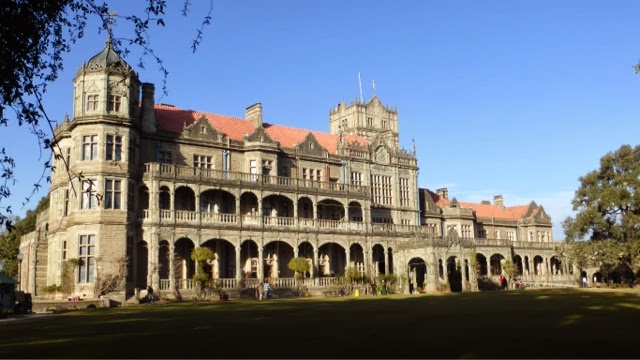
When Britain ruled India as a colony, the government based in Calcutta, found it got too hot to think in the summer, so moved every summer for a few months to my location - the hill station of Shimla. Consequently it still retains a very Victorian colonial style - well laid out streets, British looking stone houses, band stands, promenades, cafés and so on, all based along a long knife-edge ridgeline. I spent that afternoon having a wander around, finding all a bit surreal; a bit like a theme park. At the far end of 'the mall' was the Viceroyal lodge - the former summer home of the British Ruler of India and now used as a University. It was styled part English, part Indian and part Scottish and couldn't look more out of place in it's surroundings. Sat in the grounds looking at it, for a few moments I really felt like I was back home, it was so quiet, normal and comfortable for a change! Ignoring the building itself, there were a few things I found incredible about the place - firstly that during British rule a fifth of the world's population was ruled from this building. And secondly, in the drawing room two famous talks were held, formally giving India independence from Britain, then later partitioning Pakistan into a separate country with Ghandi himself in a leading role in both. A guide took us on a brief tour inside, and I chatted to the only other foreign couple there who were English architects from Southampton. The guy hated the place from a styling point of view, and also made the valid point that whilst the rulers were sat there amongst the walnut, marble and ivory, the rest of India was living in poverty. No change there today then.


Shimla is full of monkeys - roaming the streets looking for food, jumping between rooftops, swinging between trees, and in some cases stealing food from people's hands apparently. Walking with the English couple back to the town, the lady pointed at a baby monkey up a tree and said 'oh how cute', and before you know it, it's mother jumped down and hurtled towards her, screeching with teeth snarling obviously taking offense to her pointing. Her husband reacted, shouting and waving his arms and the monkeys turned and lept away into the undergrowth - a funny moment and the first (but not last) time I saw the monkey's aggressive side. 

In the end Shimla worked out as an interesting insight into colonial India and made the stories I'd heard before more vivid and real, but one day was enough for me and it was time to head out of the mountains down to warmer climes.