Friday, 13 December 2013

A Glimpse Of British India


So despite a bad start, my stay at Manali had worked out to be quite exciting and interesting in the end. It was not the sort of place that was drawing me in though and was pretty cold to boot, so it was time it move on. I'd planned for my next stop to be Rishikesh, but being in the Himalayas transport was a bit limited and the journey had to be broken over a few days, so I had to take a bus to Shimla first of all and stay the night. 

I took what they call the 'deluxe' class of bus this time, which it certainly was compared to the rattly night bus I took a few days before, but in reality is far from deluxe. I paid the rather odd 10 rupee (£0.10) charge for putting my bag in the boot and we were soon on our way, through deep grassy valleys, along the side of a long reservoir, passing a few apple orchards and lots of tall haystacks, sometimes built amongst branches of trees. I was sat by a nice Indian lady in her fifties who gave a helpful commentary of lots of things along the way, and identified herself as just working in a University, as if she was a cleaner, but at the end of the journey when I asked her name identified herself as 'Dr. G. D. Shamber, Professor of Philosophy'. I'd never have guessed. We went on, passing people making furniture by the road, cows wearing sacks on their back, many brightly painted houses advertising cement companies and mobile phone networks, and terraces built into the hillsides where people grow vegetables. What was most apparent was that in eight hours we barely spent a few minutes without passing a house or village, and there were many built in impossible-looking places up in the hills, reached across the river only by flimsy rope bridges. It was such an interesting journey, and I was glued to the window for almost the entire time.


Typical view from the bus window on the way


The Indian guys I'd been hanging out with for the past couple of days were also on the bus, and so once at Shimla we set out to look for a hotel together, taking the local bus a mile or two up into town for the cheapest fare I've paid yet - 3 rupees - or just 3 pence! We walked over the steep ridge that Shimla is built along, eventually finding a place nestled deep in the town among narrow streets. The other guys settled in the first hotel, despite the fact it didn't have a shower and they intended to stay four days, but I chose to stay next door where I could actually wash! The room was very tacky and dated and looked like it could have just about been the honeymoon suite in the seventies, but has been left like a time capsule and slowly got worn and battered. I was particularly amused by the notice on the back of the door - 'please keep the windows shut to keep the monkeys out'!
Sunset over the mountains around Shimla

I went out for tea with the Indian guys for the final time that night, eating a mushroom do piazza curry with jeera rice at a nasty looking pace they chose. In India ambience generally doesn't reflect quality though, just sometimes hygiene although not in this case. After a few days of slowly building up, the group's ringleader was now really getting on my nerves. Like many annoying people he kind of meant well, but everything he discussed was the biggest, best, fastest, most amazing, with no attempt to compromise or accept my opinion, doing his best to attempt to make anything I discussed seem trivial in a backhanded way. It had been fun hanging out with another group of travelers for a few days, especially as they were Indian and could teach me so much about their country. The other lads were very nice and genuine, but I slowly tired and agitated of top cat and in the end decided it was best to politely call it an early night and say my goodbyes. 

I had no intention of staying more than a night in Shimla as I saw it as just a stoppover, so went the next morning to buy an onwards train ticket. With a queue behind me, and people jumping in, the guy at the ticket desk quickly said there was no direct train to where I wanted to go but was very vague and reluctant to tell me all the details about times. I went to the bus window next door and, barely looking up from his newspaper, the guy gave me an equally fast and vague story. I decided to find an Internet cafe and find out times for myself and having not used the internet for a few days, before I knew it the morning had ticked by and I had decided to stay in Shimla for a day. I purposely don't keep up with the news too much whilst away, why should I, but I read there for the first about the sad death of Nelson Mandela, what an amazing guy he was.

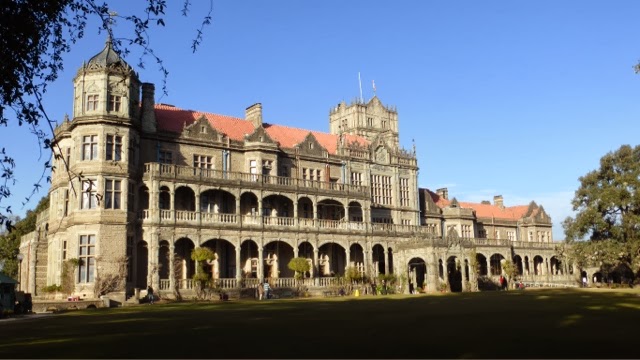
Viceroyal lodge

When Britain ruled India as a colony, the government based in Calcutta, found it got too hot to think in the summer, so moved every summer for a few months to my location - the hill station of Shimla. Consequently it still retains a very Victorian colonial style - well laid out streets, British looking stone houses, band stands, promenades, cafés and so on, all based along a long knife-edge ridgeline. I spent that afternoon having a wander around, finding all a bit surreal; a bit like a theme park. At the far end of 'the mall' was the Viceroyal lodge - the former summer home of the British Ruler of India and now used as a University. It was styled part English, part Indian and part Scottish and couldn't look more out of place in it's surroundings. Sat in the grounds looking at it, for a few moments I really felt like I was back home, it was so quiet, normal and comfortable for a change! Ignoring the building itself, there were a few things I found incredible about the place - firstly that during British rule a fifth of the world's population was ruled from this building. And secondly, in the drawing room two famous talks were held, formally giving India independence from Britain, then later partitioning Pakistan into a separate country with Ghandi himself in a leading role in both. A guide took us on a brief tour inside, and I chatted to the only other foreign couple there who were English architects from Southampton. The guy hated the place from a styling point of view, and also made the valid point that whilst the rulers were sat there amongst the walnut, marble and ivory, the rest of India was living in poverty. No change there today then.

Shimla is full of monkeys - roaming the streets looking for food, jumping between rooftops, swinging between trees, and in some cases stealing food from people's hands apparently. Walking with the English couple back to the town, the lady pointed at a baby monkey up a tree and said 'oh how cute', and before you know it, it's mother jumped down and hurtled towards her, screeching with teeth snarling obviously taking offense to her pointing. Her husband reacted, shouting and waving his arms and the monkeys turned and lept away into the undergrowth - a funny moment and the first (but not last) time I saw the monkey's aggressive side. 

In the end Shimla worked out as an interesting insight into colonial India and made the stories I'd heard before more vivid and real, but one day was enough for me and it was time to head out of the mountains down to warmer climes.

Thursday, 12 December 2013

Rafting and Religion

So still in Manali, I'd been hanging around with four Indian lads during the mountain bus tour I did the previous day - Sumamta, Kingshuk, Ashish and Ashit - who were quite taken with being able to hang out with someone from England (wow!). Safely back down at Manali town that evening, they kindly invited me for a night out with them, but them being too tight to go to a bar, it ended up being a couple of beers in their hotel room which was a laugh nonetheless. They were all once again a nice bunch, though one in particular was a bit cocky, but still tolerable - he meant well, but was just a tiny bit irritating. I'd planned to leave town the next day, but they managed to persuade me to join them on another magical mystery tour to a nearby town...

Thursday morning started with a bang, literally, when some 'builders' with a sledgehammer knocked down a wall at the bus station as I was walking past. Nothing was closed off, no warning, just a wall crashing onto the pavement and a dog and some people jumping out of the way. Never a dull moment. The minibus turned up for the days excursion, and would you believe it, it was the same crazy driver as the day before. Great! We headed down to the town of Kullu, stopping very briefly for a screen wash en-route - literally - in just a matter of seconds the driver beeped at a man beside the road with a hose pipe, he stepped forward and gave the windscreen a squirt, and we drove straight on. First on the agenda for the day was white water rafting. The boat and gear all looked safe enough, and with the guys who talked me into doing it in the first place then deciding it was too expensive and dropping out, I hopped in with another bunch of Indians and headed off for a few miles down the river, with just the guide doing the paddling. It was pretty tame by rafting standards, but given India's attitude to H&S that was fine with me, and was actually really good fun despite the water being freezing cold. The middle age couple behind me got soaked right through - like a few others they didn't hire waterproofs and did it in their smart clothes and saris!


Dressed to kill, but soaked right through

The bus then took us down the road a bit, overtaking a car or two on the way. The method for overtaking here seems to be to get right up behind a car, beeping solidly for a second or two. That car then may or may not then indicate (the opposite side to what you'd expect) as if to say 'go past', then assuming you're in a suitably dangerous position, such as going round a blind corner, you swing out and go for it! After these moves we pulled in a few miles down the road for stop two, and I had my first look inside a Hindu temple complex. When I say complex - this place had a canteen, book shop, gift shop, snack shop and ten or twenty shrines inside; no ordinary place of worship this one. The Indian lads were very helpful in explaining what it was all about, especially when we had to scramble under a very low doorway into the cave where one of the main shrines was. It turns out there are over a million different Hindu gods, but most people just worship some of the most popular ones, particularly Lord Shiva and Krishna. It's all extremely complicated, and a little knowledge is enough for me. In one part of the rooms I was  fortunate enough to see an Indian wedding ceremony in place, and they were more than happy for me to snap a pic and watch for a minute or two.

Indian wedding ceremony, with everyone sat around an open fire

We left the temple and I'd been told earlier we were staying local, but oh no. Old Colin McRae was to take us an hour and a half up a deep valley, along windy, narrow roads cut into the steep hillside, once again going too fast round blind bends. For the first time ever I was grateful when we got stuck behind traffic to slow us down, and it was also mildly calming to see barriers beside the road in many places this time though. At lunch I watched the Indian lads pose for photos by a bridge - typical of all Indian tourists both male and female, they have multiple photos taken of them in front of sometimes insignificant views and don't just stand there and smile, but instead pose and pout like models, getting kudos from their friends the more model-like the results. 


OK so not really a posing pic in this case. The lunch stop.

It didn't feel worth the drive at the time, but we eventually got to Manikaren - a natural hot water spring that had been built into a pool beneath and as part of a Sikh temple - yes, it was religion education day today! I dipped a toe in and recoiled quickly - the temperature was so hot it felt like it would melt my skin straight off. I've been in a few hot springs before in Japan and New Zealand and they were pretty hot, but nothing compared to this. There were a number of locals in the water though, and I figured that I was made of the same flesh and bones as them, so if they could take it, so could I, and very slowly inched my way in. It was too hot to stay in for long, so I had two or three goes before it was time to leave, but as I stood up my world started spinning and going white which caught the attention of a helpfully Sikh guy who worked there, who ushered me outside to cool down and sort myself out! 

The Indian guys then took me upstairs into the Sikh temple; the first time again I've visited such a place. The rules are that you have to take off your shoes and cover your head, so they gave me a nice white headscarf. It was quite different to the Hindu one earlier - in this case not so extensive or flash, people were using their mobiles whilst praying, and there were many portraits of what I guess were their gods surrounding the room. The complex also included accommodation, and they let anyone who needs it stay completely for free if they need it, whatever religion the may or may not belong to. 

We left the main worship room and I was led into a small room where you had to give the guy 10 rupees (£0.10) and in return he gave you a bag of some course and mysterious looking granules which you had to receive with both hands. I have no idea what they were for! We were finally led finally into a big canteen area where you sit cross legged on mats on the floor, and I was told they were giving us free food whether we wanted it or not, made using holy water from the hot springs; taken before not after the bathing pools I must add! Despite only having my lunch an hour or so before, they gave us a big plate of daal, curry and rice and I was told I had to eat all of it as it was 'a gift from god'. Never one to turn down a food challenge I of course rose to the task - I didn't want to seem ungrateful after all. The free food and accommodation are apparently typical of the Sikhs attitude to mankind - it's said that you won't find a Sikh beggar anywhere on the planet. 

What a bizarre but thoroughly enjoyable day. 

Wednesday, 11 December 2013

Mountains of Manali

Manali, India

Bad buses, mad drivers, mountains and skiing. It's been another crazy few days in India.

There was only one direct link between Dharamasala, the fantastic hill station I'd been staying at and my next destination - Manali, and that was the local bus. I was too late for the daytime one, and for some reason thought the nightime one would just about be OK. Surely being a ten hour journey, the bus would be of a reasonable quality I thought. I was so wrong. 

To catch said bus, I took a connecting bus from my hotel in McLeod to a few miles down the road to the main bus station in Daharamsala and waited patiently, with fingers crossed that the bus would be OK. Unfortunately what turned up was the sort of thing that you wouldn't even want to take to the next street, let alone spend nine hours on - an knackered antique of a thing, with barely any suspension, no heating whatsoever, and sliding windows that constantly rattled themselves open all night. Then there was the fact that the seats were more suited to schoolchildren - three seats on one side of the bus and two on the other, with so little legroom that I had to sit bolt upright the whole time to stop my knees smashing against the hard plastic back of the seat in front. And so little shoulder width I was squeezed solid between an old guy in a blanket and the window for the first couple of hours. I thought about giving up and hopping off when I saw a hotel along the way, but knew I'd be in the middle of nowhere, with exactly the same problem the next day. 

The road the entire way was narrow and terribly surfaced, following the contours of the lower Himalayan mountains and sometimes even turned to dirt track for short sections. We stopped every so often at ramshackle little villages for passengers to get on and off, all wrapped in old blankets. At about 11pm it started getting quite cold, then by midnight it was absolutely freezing. Normally to escape the cold you have the option of moving about, putting on the heating or putting on more clothes. The latter was all I could do, putting on almost everything I had and was still cold, as the only moving about I could do was walking around the now near empty bus shutting various windows as they shook themselves open. Needless to say I didn't sleep a wink - It was sheer hell - the worst journey I've ever had, or could hope to have.

To top this off, the previous day at the bus station the ticket man told me the bus would arrive in Manali at 6am just when many hotels would just be opening up for breakfast. But the hell wasn't over - the bus actually got into Manali at 4.15am, everything was shut, there was no-one around and being at 2,000m altitude it was still pretty cold. I had a map with some hotels on it in my Rough Guide book and got walking to get warm, in the vain hope something might be open. My only stop was on a quiet lane for a minute, watching an electricity pole fizzing and popping as it short circuited, blowing out flames and sparks in the dark of night.

After half an hour or so, it was looking like my only option was to spend some time sitting in one of the small booths that house ATM's, until finally my luck came in when through the window of a small hotel, I made out in the darkness a guy asleep on a sofa by the hotel reception. I knocked the door, then knocked louder again and to my delight (but not his) he awoke, let me in and had a room available... at £3 a night. Oh the joy I felt!


I slept until around 11am, waking up still cold, tired and generally in a foul mood. I didn't like the town nor want to be there. But after some breakfast and a walk in the warmer afternoon sun, my mood defrosted as I wandered across town, taking in a 15th century Hindu temple, stopping for a 10p cup of tea, walking through a nice patch of woodland by a river and eventually to the upper part of town where they had some natural outdoor hot springs. I passed up on the chance to bathe as they looked pretty grubby, but the locals seemed to be enjoying themselves - taking baths and washing their dishes just outside. Manali wasn't quite so bad after all.

The next day I'd booked up for a tour of some local sights, and got picked up by a minibus from my hotel. I wasn't actually sure where we were going to be honest, the place names meant nothing to me so it was a magical mystery tour. In fact it turned out that we were actually heading up one of the highest roads in the world - Rohtang Pass, stopping at a few spots on the way. Not bad pot luck eh! About half an hour in we stopped at a shack by the road where they were renting ski suits. Typical India - they were about thirty years out of fashion - proper 80's all-in-one brightly colored jobs - I'm fairly sure they bought a job lot of old gear from an American resort. At this point I started chatting with a group of young Indians who were also on the tour, who told me the reason for the clothing was that there was skiing at the top of the mountain and we could all have a go. Definately not something I expected to be doing in India!

Well won't you just look at all those curves - foreground and distance

It turned out the scary bit wasn't to be the skiing, but the getting there. The road climbed from an altitude of about 2000m in Manali up to just under 4000m at the top of Rohtang Pass, and did this via a narrow snaking road that turned back on itself time and time again to climb the face of the mountain. The road was pretty narrow and poorly surfaced, sometimes just turning to dirt track where the surface had washed away or been taken by landslides, and had no barriers despite the regular sheer drops beside. Not necessarily a problem if you take it steady but our driver did no such thing, flying into blind corners too way too fast and a couple of times overtaking other cars and buses. I don't mind admitting I was terrified. I've never in my life told a bus driver what to do, but I couldn't help but tell him twice to slow down, and at one point without even thinking shouted 'please don't' when he started to overtake. Now I've done the odd bit of extreme sport before, and only a skydive compares to the fear I felt going up this road. I was pretty delighted when we got to the top. 

One of the unsurfaced bits of the road to Rohtang pass

I wasn't expecting much from the skiing which was just, as well as it was nothing more than a lashed up bit of fun. There was no hire shop, no selecting the right size equipment, no setting up, nor qualified instructors. Instead, there was a couple of guys in trainers who gave you the only set of boots, skis and poles they had, and then held on to the elbows of people to keep them upright as they attempted to ski for the first time. It was hilarious to watch. Politely denying their help, I had a couple of runs down the only slope, which was rather icey and gentle, and with no ski lifts had to walk back up. Typical India once again, they'd managed to turn even a beautiful snowy mountaintop into a muddy, rubbish strewn mess.

Top of Rohtang Pass, 3978m

Check out the gear!

The drive down was a little less rushed though not exactly relaxing, and we stopped on the way at a frozen waterfall and then for a couple of people to do some paragliding. Needless to say I was pretty pleased when I got back to the hotel in once piece that night!

Tuesday, 10 December 2013

Himalyan heights


This is a slight different blog post to normal. A tale of a 4,342 meter high mountain, a very long hike and a night sleeping in a cave. It will be something I remember forever, for both good and bad reasons, but before anyone worries - I'm fine!

One of my plans for India before I left home was to do some hiking in the Himalayas, and I was advised recently that the town of Dharamsala is a great place to do so. On my first day here I set out immediately to find a guide to do a multi-day hike, but with winter coming and it being the end of the season, after visiting about ten or fifteen local travel agents I couldn't find a single group going. I was a bit disappointed but at the same time expected and accepted it. I thought I'd wait a day or two and see if anything cropped up but unfortunately it didn't. I knew however that there was a simple day hike to Triund - a smaller mountain which lots of people did, and I chatted to a guy in a restaurant one evening who filled me in on the details. No-one in town sold maps, most likely because it goes against the guiding services they make money from, but I felt that using the Google map and GPS on my phone, along with a bit of intuition would be enough given it was a popular route, and for the most part it was fine. And before you wonder, I have done the odd bit of hiking on moors and mountains before, so I'm not a total newbie to this sort of thing. 

I set out from McLeod Ganj (1750m); the small town I was staying in soon after sunrise on Thursday morning with everything I needed for a one-day hike - a good amount of food, drink and first aid etc, and headed on my way through the local villages. A couple of miles or so out of the village of Dharamcot, the route basic map and reality seemed to differ, so I asked locals for directions as I went. At a fork in the path it seems I went the wrong way, and the path slowly got narrower and more off camber. I kept going, thinking it would meet another route, but after scrabbling down a bank to a stream the path disappeared. I decided it was definitely the wrong way, so frustratingly turned back to the point I thought I may have gone wrong - half an hour wasted but no harm done, and I was back on track. I continued uphill, and after a couple of hours I reached a ridge, arriving at the grassy peak of Triund (2825m) and saw for the first time the spectacular view of the Dhauladhar range - a line of snow capped mountains. I grabbed a cup of Chai - milky Indian tea - from one of the makeshift cafés and had a break for half an hour, admiring the view.

Small Buddist shrine at Triund, part way up

As I'd made good time, I decided to go to the point on the mountain where the patches of snow began; known as the snow line, and the guy at the cafe told me it was a straightforward hour and a half hike, so I head onwards and upwards. About halfway along I overtook four Indian hikers and chatted briefly as I passed. The fourth guy turned out to be an experienced local guide who they hired, and I chatted with him whilst he waited, mentioning in conversation that I couldn't find a group to go with so was just out for the day. 'We're heading for the Indraha Pass' he said, 'and you're welcome to join us - we're sleeping in the cave tonight, and you can hire gear at the next stop if you want'. I'd read about the route and cave - the starting point for the final ascent of the pass, and it sounded like a great offer. But I told him I'd think about it and see him at the snow line, and walked on ahead.

The newly formed Team Indraha

When they arrived at the Snow Line Cafe, I asked more questions about the weather, their plans and gear, and decided it would be fine. Too good an opportunity to miss. I had another cup of chai, bought some extra food and hired some sleeping gear from the cafe, who provide such things for hikers. With a sleeping bag and roll mat tied on my rucksack, I set off with the four Indian guys towards the cave, along with hilariously, a stray dog who'd followed them since Triund a few miles back! The terrain slowly turned from grass and trees, to a more desolate landscape of rocks and scrub. We walked up what used to be a glacier, but now is now just a rocky bed - global warming caused it to melt a few years ago, but their pace was a lot slower than mine - the guide was very experienced, but this was the first hike for the other guys. After a couple of hours, at around 4.30pm we reached Lahesh Cave (3274m), a place where shepherds often sleep in the summer, and it hit me - I was staying in an actual cave, up a mountain! 


We all chatted outside for a bit - they all worked in the finance department of an American pharmaceuticals company so I learnt a bit about their lives. Then came a problem - the meths cooker they'd hired wouldn't light, and they'd not checked it. The guide tried to mend it but it couldn't be fixed, so instead him and I went out to gather stuff to light a fire. We were well above the treeline so there was no wood, and all we could find was bracken-like material. Remarkably, they managed to get a fire going with it for long enough to boil a couple of pans worth of 'Maggi' - India's version of supernoodles and we ate until full. Phew.

Fantastic view and sunset. We were so far up the horizon looked plain odd.

Tea time

Cave man. And dog.

Funnily enough there wasn't much in the way of entertainment, which was a strange sensation for me. I'm always surrounded by sometime to read, somewhere to go, something to do, but here - nothing. The guys had a pack of cards, but without much light they decided to just go to sleep. At 8pm! I got into the sleeping bag fully clothed, which wasn't enough for the zero degrees of the cave, but would have to do. The guys all slept in a line for warmth, and I was stuck on the end between them and the stray dog! She had followed us all the way, and decided to come and huddle up next to me for the night to keep warm! As far as a pillow goes, my rucksack folded in half had to make do. It was eleven hours between going to bed and waking up, and I reckon I slept for about three of those - it was pretty awful. I was cold, the guys snored, the mat and pillow were uncomfortable, and to top it off the dog barked twice in the night which startled everyone, for us to discover she was barking at a mouse that was running round the cave! Some experience.

Sunrise

At daybreak it was time to get on. With a big hike ahead of us, I was expecting the cooker to get going for a big breakfast, but the guys had no such plans, and I had to make do with a couple of handfuls of almonds and some bite-size chocolates. With a mountain stream nearby though, at least we had plenty of water. I walked with the guys for half an hour or so, but spent three-quarters of the time with the guide waiting for them to catch up - they were all extremely unfit. I wanted to get back to my hotel that night, and there was no way this would happen at this speed, so I asked the guide if the route to the top was straightforward - he said 'yes, just follow the painted arrows and piles of stones, and we'll follow on behind'. The path on the whole was well-constructed, well marked out, and whilst steep; pretty safe to walk on. At an altitude of over 4,000 meters though, I was well into the zone where the altitude has an effect - I had a slight headache, my pulse was very fast and my breathing heavy; having to stop every ten paces or so. Up to 4,500 meters though it isn't necessarily unsafe, just uncomfortable. 

Three hours after leaving the cave, the end was in sight and after walking the last five meters across soft snow, the most amazing view opened up, as I finally reached the ridge of Indrahar pass - 4,342 meters above sea level - just over half the height of Everest. In front of me lay an amazing panorama of the next range of even higher mountains, further into the Himalayas. I stopped in awe for half an hour taking it in, eating some snacks and snapping some pics. 

At Indraha Pass, 4,342 m

I couldn't stay forever, tempting as it was, so descended slowly and carefully, passing the Indians after an hour or so (I did ask but didn't remember their names!). They were going to be camping halfway down at Triund, whereas I wanted to get right to the bottom to my hotel, so we said goodbye and I pushed on back. About halfway down the tiredness started kicking in - going downhill requires concentration rather than pure fitness and is very hard on the knees, as well as toes which constantly bang against the inside of your shoes. I really couldn't wait to get back, yet was getting more and more tired. 

A few hours later I was finally down in the valley - it was heaven when I eventually got to the surfaced road, and even better when I saw the hotel and limped in, slumping straight on the bed. After over ten hours, and about fourteen miles of walking, seven hours of which were just descending the 2,600m altitude drop, I was finally back. I'd managed to squeeze into two days what the guided tours do in four and was really paying the price. Everything was aching terribly and I was extremely hungry, but I'd done it. The experience of a lifetime.


P.S. - in case you were wondering - yes I'm still keeping up with the blog, in fact I have four of them written and saved on my iPad ready to go, but like every simple task in India, just finding WiFi is an ordeal and it's taken days to do so!

Tuesday, 3 December 2013

Chilling in McLeod

Dharamsala, India

India has many hill stations - mountainous towns where people escape from the heat of the mainland during summer, and are something that came from the days when the British ruled here. The area of Dharamsala on the edge of the Himalayas is a perfect example and, I decided, the perfect escape for me from the chaos, rather than the heat of Delhi.


---

After a great few days hanging out there, it was time to escape the noise, chaos and pollution, and I chose Dharamsala for it's hiking and beauty, on a recommendation from a friend who'd been before. India is known for its train network, but unfortunately where I was heading in the north is a bit too out the way for trains, so I booked a bus. Bizarrely though, rather than leaving from an actual bus station, I had to go to a Tibetan colony in one of Delhi's suburbs, because as I found later, most people who both live in and visit Dhamarmsala are from Tibet. From where I'd been staying I got the Metro across the city to the nearest station, then took a cycle rickshaw ridden by yet again another sixty-odd year old guy to what was supposed to be the bus stop. 

Despite the drivers plea, it wasn't, but with a bit of asking round I was pointed a few hundred meters up the road to a dusty car park underneath an unfinished flyover, where loads of people stood but no buses. It didn't feel right at all, so I asked around and found I was indeed in the right place - another passenger said that the buses to Dharamsala were non-government ones and therefore were only semi-legal, lacking a permit to pick people up here. Great. When I eventually found the guy from my bus company (there were a few), he told me to keep waiting, and said taxis would take us to the actual boarding point. I was pretty bemused and perplexed by all this - all I wanted was to get on a bus. After nearly an hour stood round with a bunch of Tibetans, all hundred or so of us were loaded into various taxis and taken to another dusty patch of land where after witnessing a motorbike ride uncontrollably into the side of a car, eventually the buses turned up. It was all very weird. 

 
The bus stop which wasn't a bus stop

Ten hours sat overnight on a bus is exactly as it sounds; pretty crap. The seats weren't great, and the sliding window by me continually rattled itself open all night. I was sat next to a guy, who with his three mates were heading back north to uni, studying to work in textile production and they were all good to chat to during a stop in the 'motorway services' - an open fronted steel shed. Back on the road, I managed to sleep a little on-and-off for a few hours, and at 4am we stopped in a tiny village in the hills for another break. I awoke and bleary eyed got off to stretch my legs, and have a tea from a guy selling from a makeshift stall on the street. A fellow passenger started talking to me who was originally from Tibet, but now living in New York, and gave me a full-on insight into the problems of Tibet, his life as a film maker and how both his parents and grandparents were killed when the Chinese invaded and took Tibet in 1950. Very sad, but a lot to take in in the middle of the night when you've just woken up!

After a curry at the 'motorway services' with the three students

At 7am we arrived in Dharamsala, more specifically the nicer upper town called McLeod Ganj and I set about trying to find a hotel. There's no need to stay in hostels in India as hotels are so cheap, and after a bit of looking around decided to treat myself to a nice en-suite double room, at the grand sum of £6 a night!

I was instantly taken by McLeod Ganj - a very tranquil and peaceful town, set into a steep hillside in the Himilayas at 1,750m altitude. It had a certain spirit about it; peaceful, relaxed and green with amazing views, and a total contrast to Delhi. I loved it so much that the couple of days I intended to stay soon turned into a week. Unconsciously, it's basically ended up being a holiday from traveling, if that doesn't sound like too much of a contradiction. I've been on the move quite a bit over the past few weeks without allowing much time to just relax, nor have I really had my own personal space for a while as I've been mostly staying in hostel dorm rooms, so the week here has been perfect. But because of that, it doesn't really make for a particularly riveting blog this time.


I started as I meant to go on and took it pretty easy the first day. I'd not been online for a week; Delhi seemed to have a big lack of internet access, so spent two or three hours catching up on everything then went for a wander round town, walking around the nearby woods on the way. I was a little bit taken aback though when I turned a corner, and out of the blue found a bunch of monkeys hanging out on the track by a bin. Over the week I saw them all over the town - mostly jumping between roofs and climbing along telegraph wires! They were harmless though.

Cheeky monkeys

The very lively but small town centre

I continued to explore the town centre for a couple of hours, which was a bit slap-dash and dirty but quaint in it's own way; with steep and narrow street housing the usual hotels, travel agents, restaurants, cafés, gift shops, alongside monasteries, massage, yoga and meditation places. It's one of those places where you can happily just sit in cafés reading and watching the world go by. And for some of the week that's exactly what I did. 

There's not much point in giving a blow by blow account of the week, cause for the most part nothing much else happened apart from a walk to some waterfalls, a great Tibetan full-body massage, and a bit of looking round town. I did go on a slightly longer trek for a couple of days though, but that deserves a separate story... coming in a day or two. A few things worth picking out:

Cinema
I'd not had the opportunity to watch any films in English for a couple of months, so when I saw there was a small cinema in town playing films mostly with the theme of India, Tibet and traveling, I went along a couple of evenings; but it wasn't your usual cinema. It seemed professional on the outset, but turned out to be a basement room under a shop that a young guy had painted a funny shade of blue, pinned some cloth to the wall, and stuck some old office chairs in. It was actually really good though, despite every film in his collection being an illegal internet download with at times fairly sketchy quality. Although there being a published schedule of films posted around town, the first night I visited I was the only one there, so he let me pick my own! I saw Jobs - the life story of Steve Jobs of Apple, then another night with a few other people this time, saw The Darjeeling Limited. 

Tibetans and Buddists
Despite being in India and a popular holiday destination for natives, McLeod Ganj is actually mostly populated by people from Tibet. They live here in exile after China invaded and effectively stole their country in 1950, and it's also home to the Dalai Lama - the famous Buddhist leader and figurehead of Tibet. A number of Tibetans are also devout Buddists and therefore live as monks and nuns, so in McLeod you see many walking around doing their day to day activities. I found them to be very peaceful, smiley and good natured. The nuns interestingly shave their heads and dress exactly the same as the men, in loose red robes so it's not always immediately apparent which sex they actually are! The main Buddhist temple where the Dalai Lama hangs out is open to the public, so I had a wander around one day, seeing the various deities they worship, and spinning prayer wheels they turn as they pass amongst other things. It was built in the sixties, when the Indian government said the Tibetans could settle here so doesn't exactly have history or class though.

Prayer wheels

Monks hanging out


One of the Buddist temples

Travellers
I've not met quite so many fellow travelers this past week, I guess as hotels aren't as sociable as hostels, but there have been a couple. An Aussie girl I was chatting with in a cafe who's here for a few month to learn the Tibetan language and was telling me about that, then later a Kiwi guy called Barry who started talking to me in a restaurant. He was this little chap in his late 40's, who with no family to support fluctuates between driving buses at home, and coming to India to embrace all sorts of new age stuff. He had some interesting ideas and advice on places to visit, but when we parted I got the feeling he was a bit of a lost soul, like a few blokes of that age you see here, wandering round with long grey hair, loose fitting cotton clothes and leather sandals.

Food and drink
I've had some cracking meals in McLeod well worth mentioning. Because the town is Indian, populated by Tibetans, and often visited by Europeans there's an eclectic range on offer. Amongst many great curries, I've eaten Tibetan porridge with sliced banana for breakfast most days, a great pizza in an Italian restaurant, Tibetan momos (steamed dumplings stuffed with spinach, ricotta and cheese), Singapore lamb chowmien noodles, and Hong Kong skewers of veg and pork served with rice. This all sounds quite extravagant, but £2-3 can get you a pretty decent restaurant meal in India. A lot of the food I've eaten so far has been vegetarian - and before you say 'you've changed!', meat isn't that commonly eaten here for both cost and religion, and it can also be pretty shoddy quality and poorly cooked, so with a few exceptions I'm following the advice to keep off it and avoid getting Delhi belly. The food is so tasty in general that I seem to be coping fine with this lack of meat though, and they often substitute it with paneer (a type of cottage cheese), tofu, or beans. This is not a permanent change of diet I must add!


Sunday, 1 December 2013

Cricket, fish and crowds: more Delhi

Delhi, India

Overwealming and chaotic, yet fun and enjoyable - that's about the best way to describe my experience of Delhi.

My first day in India was to be a gentle introduction I decided, as there was a LOT to take in. Once my Couchsurfing host Nishu had gone to his exam I rested in the safe confines of his flat for a while, just to get over the first hour of chaos - it had been a lot to take in. I'd not eaten or drunk since the night before so after a couple of hours I took my first tender steps outside to attempt to find somewhere, but had no idea where to go, what was safe to eat, and where was safe to walk. After strolling through the hospital grounds where Nishu's doctors accommodation is located, I found the hospital snack shop and bought a sandwich with a vegetable patty inside, and a litre of water... all for £0.40. Wow, this country really is cheap.


Dr Nishu, my host

 Make do bed for a few days

Nishu got back mid afternoon and we went to the mess - the staff canteen which ironically is a very unclean, ahem, mess. Cobwebs everywhere, dirty floors, and about four pigeons nesting on the sills near the ceiling and occasionally flying around. It's a good job therefore that the food was superb - Roti's (bread) with subzi (curried potato), Dahl (spicy soup) and an omelette, guess what, also spicy! No hotter than I've had before though. Around four pm we walked to the main road and I then had my first encounter with a cycle rickshaws ridden by a guy, I guess, in his seventies, towing two of us with gears that were so high that he occasionally had to get off and push just to get us going! Nishu was doing the leading, and he then took me to an area called Chandny Chowk, where Nishu hailed another cycle rickshaw to give us a tour of the area. Now this place was like nothing I've ever seen before. Even busier and wilder than the scene that greeted me when I first arrived. First of all there were people everywhere, and I mean everywhere. Motorbikes, cars, lorries, rickshaws, bullocks towing carts, cycle rickshaws, stray dogs. Then the people carrying things on their shoulder, beggars kneeling on the street, homeless people lying on the central reservation. And on top of this, people selling everything you could imagine. I heard, perhaps unreliably that this is the busiest street in the world. Must be one of them at least.


The next morning Nishu disappeared off at nineish to the hospital, and I decided to stay in the room and open my Rough Guide for the first time, to read a bit about India in general and plan a bit of a route for the next few weeks. I also had a few days of the blog to catch up on writing - it's pretty easy to get behind and start forgetting things! I went to lunch at the mess with Nishu, and noticed the food was bought out by a boy of around twelve. I quizzed Nishu on it, and as we hear in the media at home sometimes, it is reasonably common - typically for a few rural boys who's parents can't afford to look after them apparently. Now I, probably like most of you can't get my head around this, and I'm surprised that a group of educated Doctors accept it as well, but guess it's just normal and not thought about. After lunch on my own, I braved going a bit further for a stroll around the local area. This time I saw goats grazing the verge, a horse and cart moving stuff, people cutting hair and shaving beards on the roadside and bikes overloaded with long lengths of steel amongst other things.

Nishu finished work around half four, and along with a female neighbor who's name I forget, took me out for a real experience at the local night market as he wanted to buy some fish for a party the next day. The level of hygiene was poor beyond belief, though I had seen similar in Cambodia a few years ago so it wasn't too shocking - the photos do the talking on this one. It was interesting to watch the way they descale and cut the fish, using a huge fixed knife sticking up in front of them. WARNING! BLOOD AND GUTS TALK FOLLOWS! More eye opening though was the barbaric way in which they killed the chickens. These chickens, which are in an awful condition are kept live in tiny cages for the customer to select, then are slaughtered there and then. The first 'normal' way is to just chop the head off, no wringing. The second 'halal' way for Muslim customers though, is to half cut the throat, throw them in a barrel, then let them bleed to death slowly - you could hear them flapping round for a good twenty to thirty seconds before they finally stopped. It was quite a sight, but totally barbaric, torturous and cruel in my opinion.


Night market

Most doctors work six days a week in India, so on Saturday I headed into town to do a bit of touristy stuff, going to one of Delhi's main sights - the Red Fort - a huge read sandstone complex with many buildings, temples and parks inside, and had a guard blow his whistle (old school) and get quite angry at me when I had almost reached the centre of the complex as I'd neglected to buy a ticket; whoops! An accident of course. There was a small but good museum in there as well on India's struggle for independence from British rule. In case you didn't realise; we shamefully claimed India as our own territory from about 1600 to 1949 and caused much long lasting damage in all sorts of ways, which is partly why our Government has allowed so many to emigrated to Britain since then. Ninety thousand Indians died fighting as part of the British WWII campaign as well. Something to think about next time you hear someone being racist or criticising our immigration policy. 

Anyways, so much happened in five days in Delhi, there'll be a part II soon. This could be a regular thing in India...


Friday, 29 November 2013

Jordan photos

A bit behind with the times here - my photos from Jordan are now online here

You don't need to be a Facebook member to see them